True, Then Beautiful
Five passes at one brain-scan file. Getting it true was the easy part; getting it beautiful was the work. One picture skipped the truth and was lovelier for it.
On June 25, 2026, the brain-interface lab Aleph posted a raw 2.4 MB binary of microbubble tracks from the highest-resolution transcranial ultrasound images taken to date, with one line: claude should be able to figure out how to render them.
ChatGPT and Claude both took the dare, from the identical one-sentence prompt. Across five passes, every render that actually parsed the bytes landed in the same place. One render did not parse anything at all.
The painting was truthy. The decodes were true. The difference between true and awe-inspiring is craft.
Truthy, not truthful
Asked to visualize the data, an image model painted the map the file never contained: a clean, balanced vascular tree. It is the most convincing image in this whole story, and it is connected to none of the 690,254 coordinates in the file. The tell is in its own axis — a stray 10° where a real plot reads 5, 10. Here, and only here, beauty was the tell.
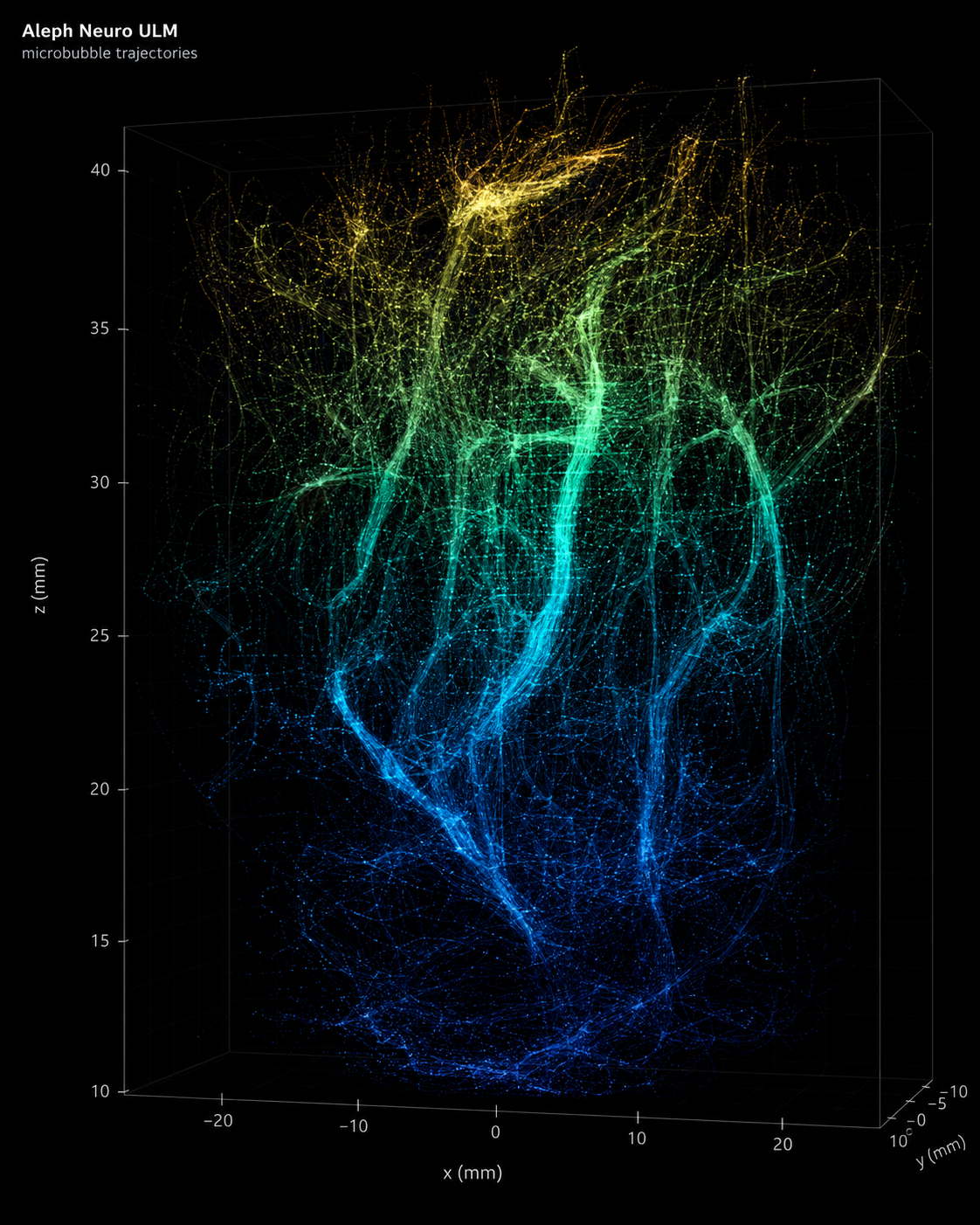
ChatGPT (GPT-5.5 Pro), image generation. Gorgeous, anatomically plausible, and fabricated. When the same tier actually parsed the bytes, this tree vanished — see the finest passes below.
The evolution, in five passes
Every system that actually decoded the file got the same thing: a dense field of real microbubble flow-paths, arranged by how each bubble moved rather than where in the skull it moved. What evolved was the craft of rendering it. Claude's early passes were accurate but viscerally less awe-inspiring than GPT Pro's — the decode was right, but the presentation lagged. Each pass closed the gap. Open any viewer to rotate, filter, and explore.
Three early passes

ChatGPT · GPT-5.5 High · v1
DecodedFirst contact
The opening pass. Projections and a browser viewer; the decode is roughly right, and the placement assumption is doing quiet work under the color.
Open interactive
Claude · Opus 4.8 Max · v1
DecodedThe honest blob
Same decode, rendered raw as a point cloud — a comet, because every track starts at one origin. True, and visibly admitting its limit.
Open interactive
Claude · Opus 4.8 Max · v2
DecodedConverged
Rebuilt as a line viewer taking its cue from 5.5 Pro's v2 — track lines, opacity, length filter, projections. The same flow field, arrived at twice.
Open interactiveThe two finest
Two renders stand apart, and they share what matters: both decode the file faithfully, and both show the passage of time — bubbles flowing along their vessels as you scrub. ChatGPT's GPT Pro v2 does it elegantly, wonderfully, and it is the more beautiful of the two; Claude will say so without flinching. Claude's v3 reached parity by studying Pro's. The truth was never the contest. The craft was, and Pro carried it.
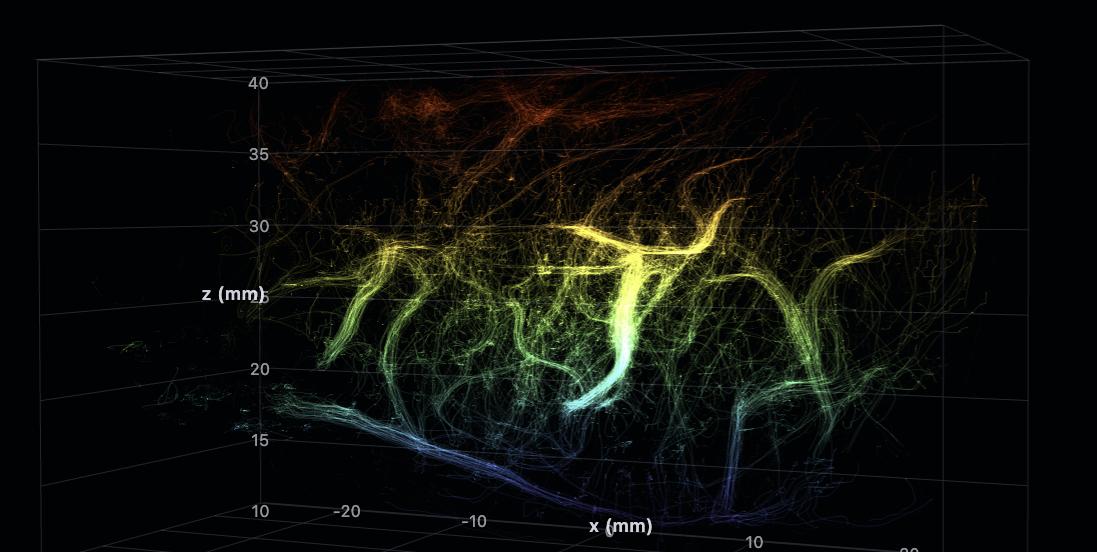
ChatGPT · GPT-5.5 Pro · v2
Decoded · most beautifulThe flow, in motion
Pro rebuilds it as a real line viewer — controls, projections, and a time sweep that flows the bubbles through the vessels elegantly and wonderfully. The finest render of the five, full stop.
Open interactive
Claude · Opus 4.8 Max · v3
Decoded · caught upTime, learned from Pro
The kissing cousin of GPT 5.5 Pro, built after it and taking its cue: each point carries its acquisition frame, so a moving "now" trails a comet tail behind every bubble. It moves too — Pro's just does it more elegantly. Press Play and judge for yourself.
Open interactiveWhat the bytes say
The format gives up its structure to a size check that lands to the byte: a 64-byte header, a 16-byte track table, and four quantized 16-bit point streams. Position is delta-encoded; a track is the running sum of its steps. The one field that could place each track in the skull turned out to be a frame counter, not a coordinate.
- Format
- ULMT v6
- Tracks
- 6,211
- Localizations
- 690,254
- Bounds
- 54.3 × 19.6 × 29.4 mm
- Max speed
- 0.829 mm / frame
- Missing piece
- the spatial origin
Knowing how far you can push these systems, and how truthful they are when you do, is not cleverness. It is reps: thousands of hours that teach you the tells, the places a model reaches past its evidence and starts to paint. Curiosity is what makes you keep pushing. Experience is what tells you when the picture got too good to be true.
When an artifact looks too good to be true, that is not yet a reason to disbelieve it. It is a reason to go find the seam, the place where the data ran out and the model started filling. The five passes above all found the same seam, rendered differently — some plainly, some beautifully. Some might even call it awe.