Composer’s pianist
Works were written for him, built around his decisions, and even made from recordings of his own piano sound.
Composer’s pianist, traditional virtuoso, teacher, recording artist, and living witness to postwar American music.
A program proves a date and repertory. A review preserves contemporary reception. A liner note can preserve the performer’s role and the composer’s intent. Oral history establishes that a remembered working relationship belongs to the life story—even when the surviving archive has not yet supplied the exact date, venue, or repertory. The source type remains visible throughout.
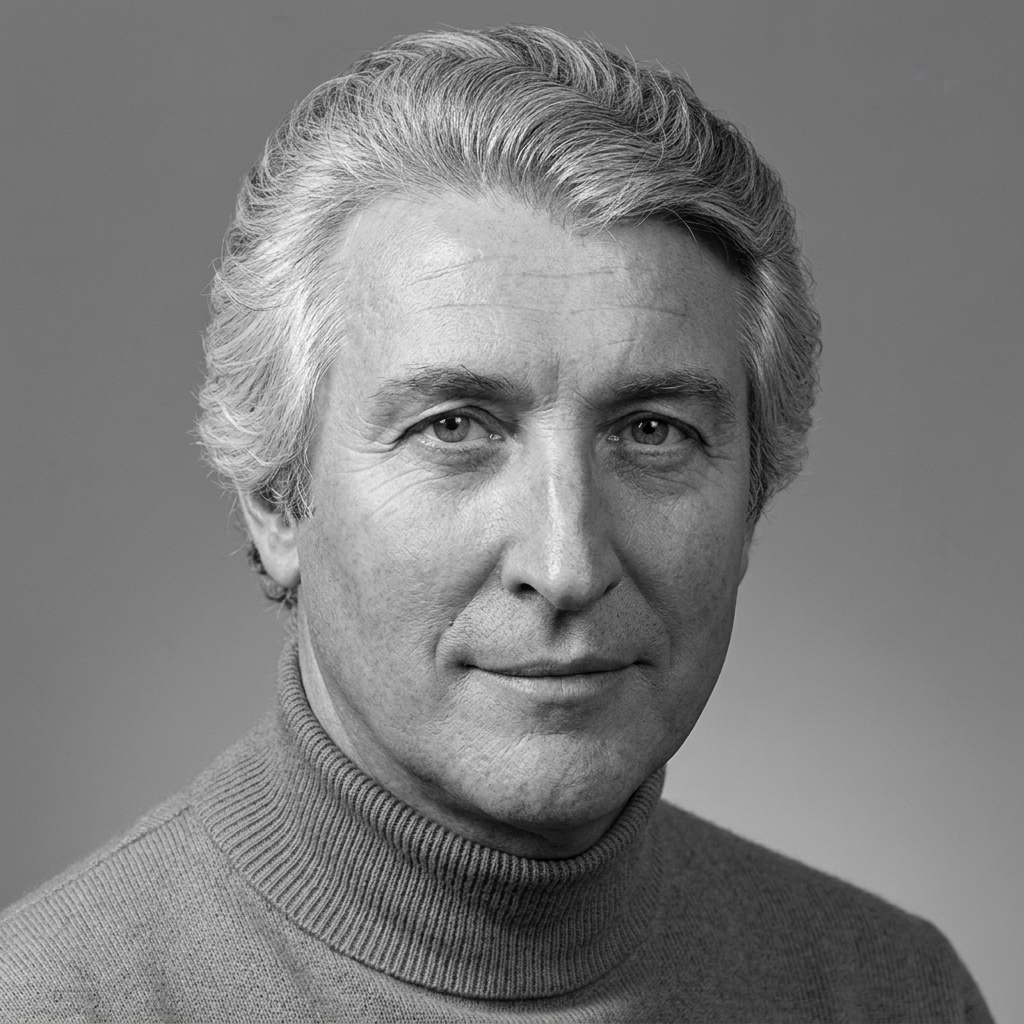
Born on October 18, 1935, Dwight belongs to a particular class of musician: a composer’s pianist.
He grew up in rural Minnesota and made his first orchestral appearance at twelve — Beethoven’s First Piano Concerto in Minneapolis, as first prize winner in a young artist competition. Two consecutive Fulbright fellowships carried him to Europe: Edwin Fischer in Switzerland, Karl Richter in Germany, graduate study at the Hochschule für Musik Berlin, and — on his own account — a Berlin debut in 1958.
By 1962 he was the San Francisco Symphony’s soloist under Arthur Fiedler, invited back the next summer; by 1963 composers were writing works for him — Martirano, Erickson, Rush — and he was premiering them and keeping them. A third fellowship, the Fulbright-Hays professorship at Keele, came fifteen years on. That work with composers came to define much of his public identity.
He has the technique and traditional formation for Mozart, Beethoven, Chopin, Ravel, Brahms, Liszt, and Rachmaninoff. Composers also trusted him to learn, premiere, record, repeat, and defend scores that had no established performance tradition. The Ozawa–Martino engagement was not an eccentric detour. It was the major-orchestra expression of a career already built around difficult American music.
The internet preserves his career badly because much of it happened through premieres, university residencies, radio broadcasts, museum concerts, composer-led organizations, short-run LPs, and performances that survived only on analog tape. Those systems produced real musical influence without producing the celebrity biography that a major commercial label would have left behind.
Works were written for him, built around his decisions, and even made from recordings of his own piano sound.
Mozart on CBC and Beethoven’s Diabelli Variations at Carnegie sit inside the same career as Cage, Custer, and Fuller.
More than forty performances of Watts’s Sonata show that he built repertory rather than merely collected first performances.
Teaching ran alongside the concert career for decades. When focal dystonia ended professional concertizing, the studio became the principal place where the performing tradition continued.
The list below brings together direct archival relationships and relationships preserved by Dwight’s oral history. Select any name to filter the chronology.
Study and mentorship during a Fulbright in Switzerland.
Study and work during a Fulbright in Germany.
His piano teacher at MacPhail in Minneapolis — the teacher who stands between Brainerd and Berlin.
The Frankfurter Allgemeine critic whose reviews, a 1961 profile records, renewed his Fulbright for a second year and led to a European concert series.
Quoted in a 1961 profile praising his command from Mozart and Beethoven to Schoenberg, Berg, and Webern. Printed as “Prof. Dr. H. Grabner,” and kept as printed.
A violinist of Minneapolis, on shared Minnesota bills with his son through the 1940s. The Brainerd pages that open this record carry them both.
Working relationship recalled by Peltzer in the 2024 oral history; engagement details remain to be anchored.
Working relationship recalled by Peltzer in the 2024 oral history; exact orchestra, repertory, venue, and date remain open.
Conducted Peltzer’s San Francisco debut — Bartók’s Third at the Pops, 11 August 1962 — and invited him back for Brahms’s First in July 1963.
Working relationship recalled in oral history; also part of the institutional context surrounding Cage and the New York Philharmonic.
Working relationship recalled in oral history; exact engagement remains unresolved.
Working relationship recalled in oral history; exact engagement remains unresolved.
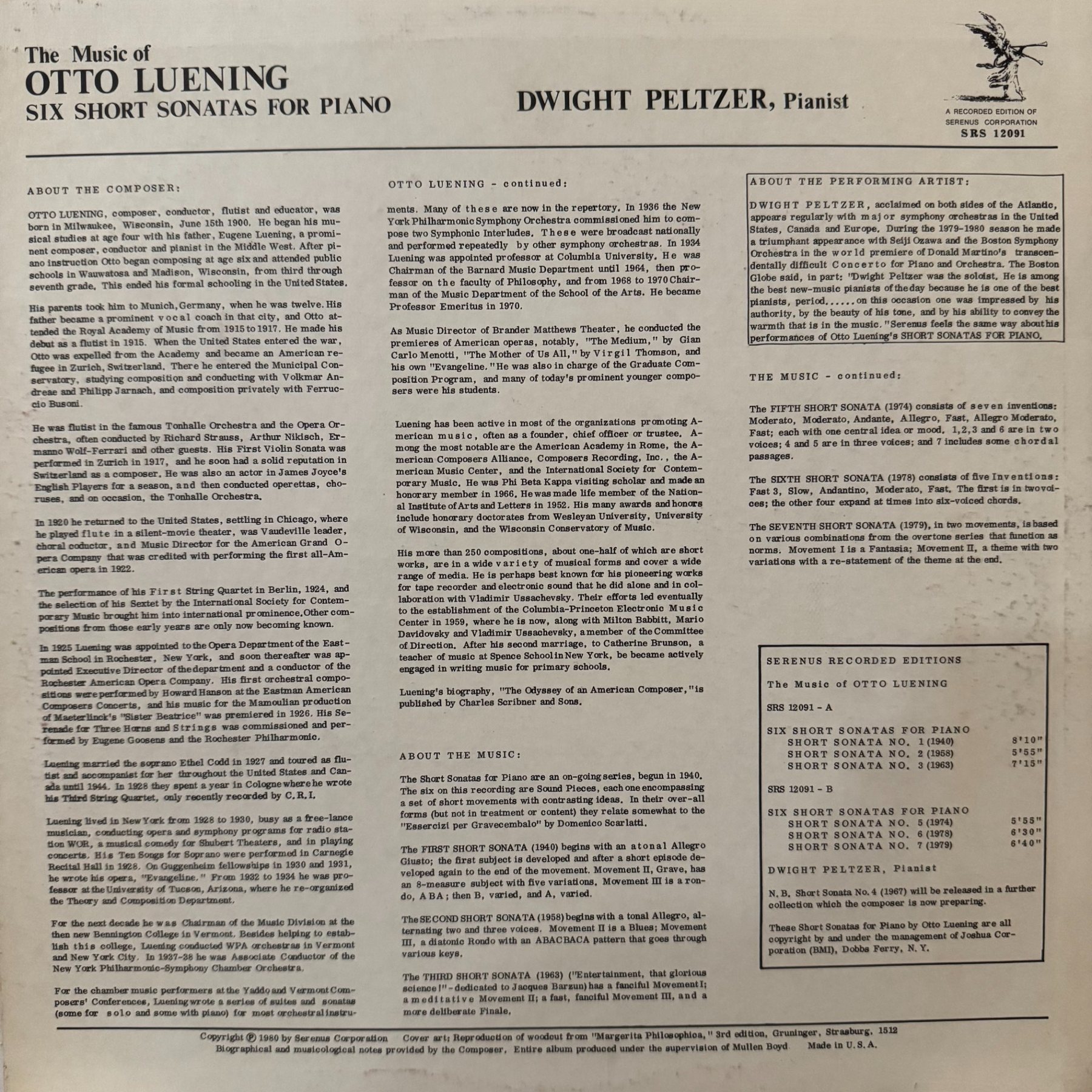
Peltzer recalled Luening as a colleague and recorded Luening’s Six Short Sonatas for Piano on Serenus SRS 12091.
Conducted Peltzer and the Boston Symphony in Donald Martino’s Piano Concerto, April 18, 19, and 22, 1980.
Conducted the 1977 premiere of Elliott Schwartz’s Chamber Concerto III with Peltzer and the Saint Paul Chamber Orchestra.
Conducted Peltzer in Mozart’s Piano Concerto No. 22 with the CBC Vancouver Chamber Orchestra in November 1965.
Conducted Peltzer in Mozart’s Piano Concerto K. 414 — with the Victoria Symphony, in Montreal, and on the preserved CBC Montreal Orchestra broadcast.
Conducted the West Coast premiere of Erickson’s concerto with Peltzer, directed the first two Cabrillo Festivals — where Peltzer played the festival’s very first concert — and led the Performer’s Choice orchestral programs. Music director of the Oakland Symphony.
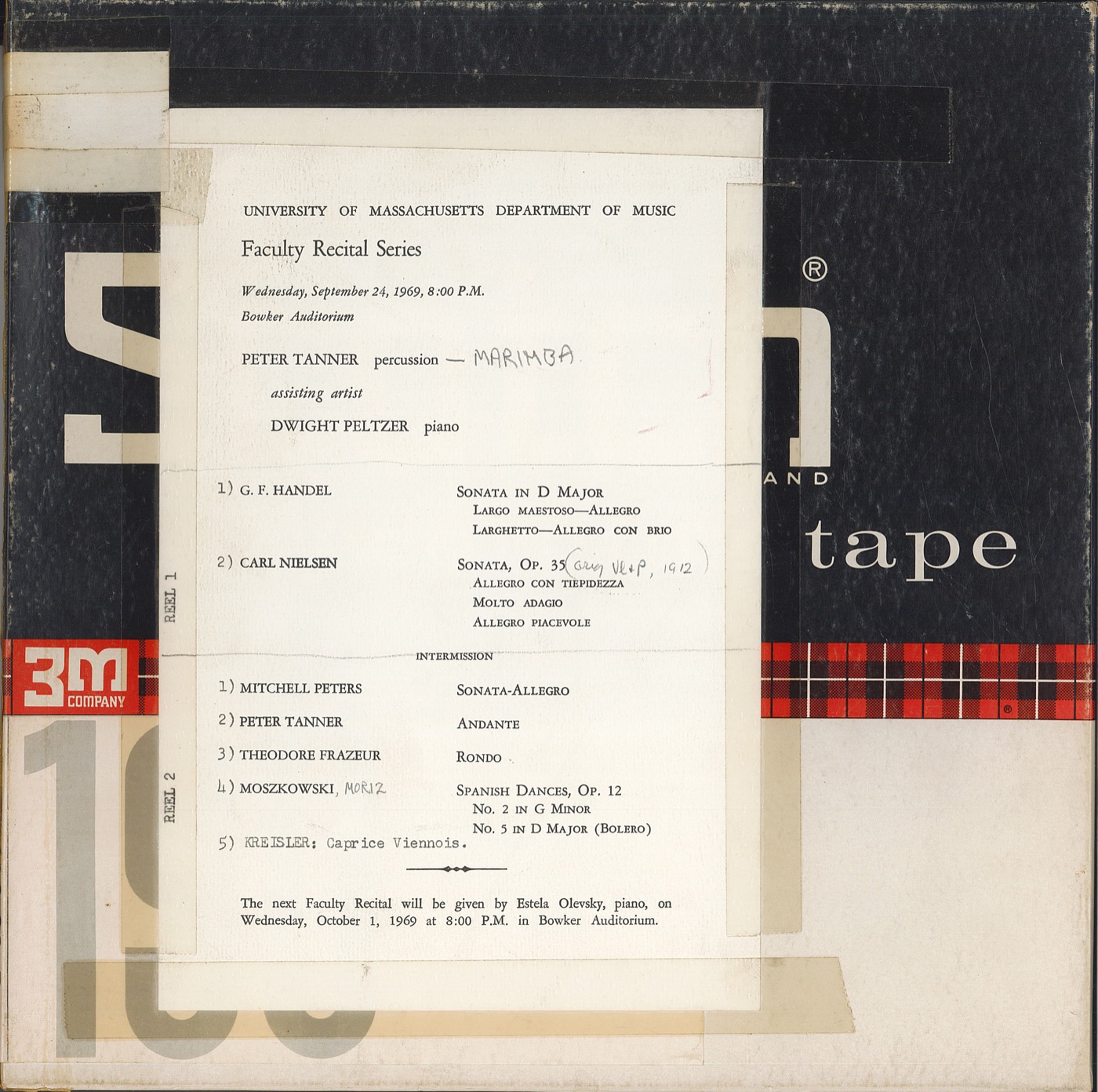
UMass percussion colleague. Peltzer assisted Tanner’s September 24, 1969 marimba recital, and Tanner assisted the Peltzers’ November 1, 1970 duo program — both evenings survive on WFCR tape.
Co-pianist in Cage’s paired duration works at Tudorfest; ensemble colleague in the April 1964 events.
Tudorfest colleague and central organizer within the San Francisco Tape Music Center circle.
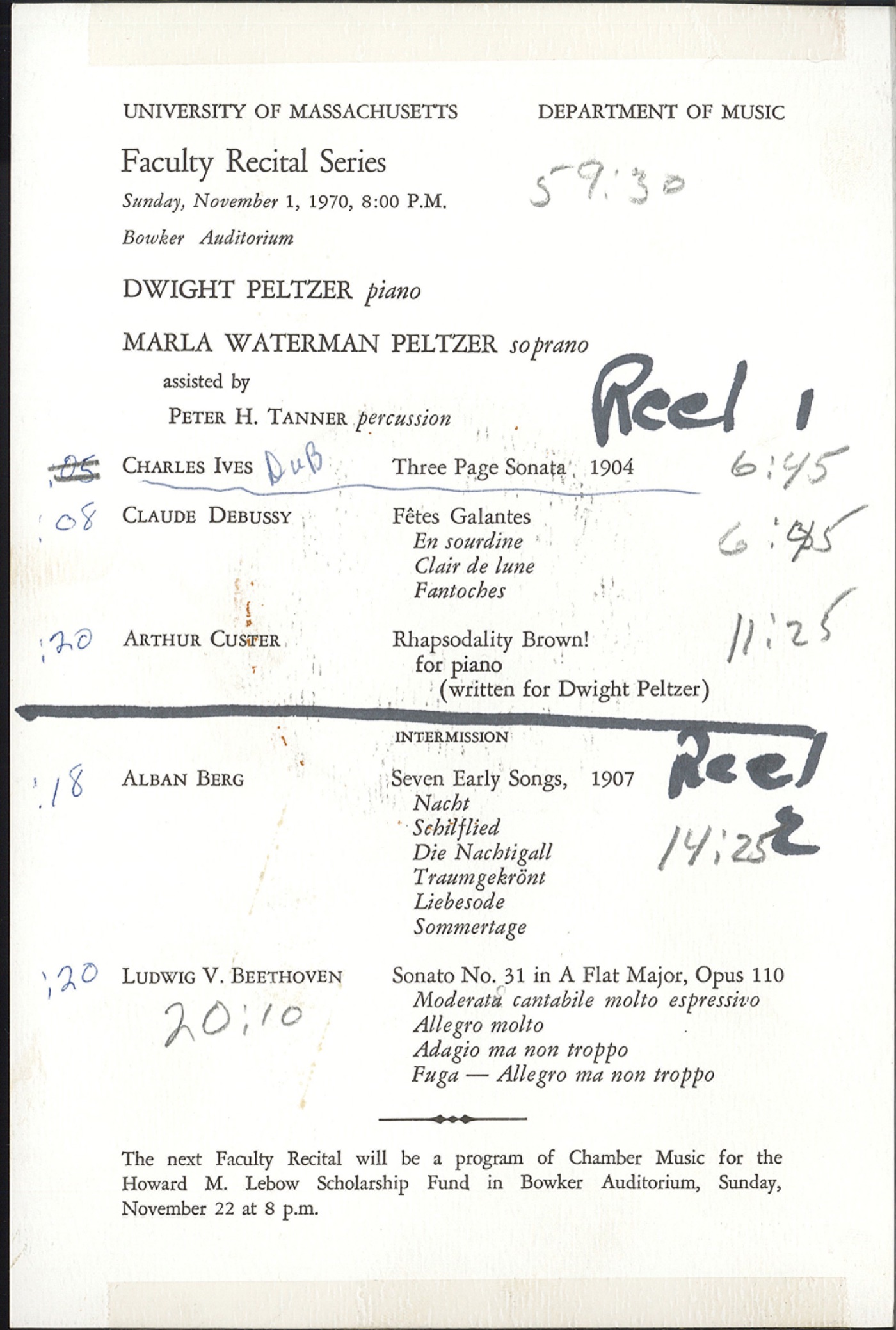
Spouse and recurring recital collaborator, from Baber songs and UMass broadcasts to the Keele year and Princess Margaret recital. Her Berg Seven Early Songs, sung with Dwight at the piano on November 1, 1970, survive on a WFCR tape — the only known recording of the two performing together.
Recording partner for Henry Cowell’s Complete Works for Violin and Piano.
Shared a Queen Elizabeth Hall program of American music during the Fulbright-Hays year.
Performed in the all-John Watts MoMA Summergarden program with Peltzer and Watts.
Ensemble colleague in the April 3, 1964 Tudorfest performances — and, the print record now shows, percussionist beside Peltzer in the Performer’s Choice concerts of 1963–64, years before FM synthesis made him famous.
Ensemble colleague in the April 3, 1964 Tudorfest performances.
Ensemble colleague and member of the Tape Music Center community.
Ensemble colleague and co-founder of the Tape Music Center.
Recorded Arthur Custer’s Rhapsody and Allegro with Peltzer for Serenus.
His duo partner of the Bay Area years: the Bartók Sonata at the first Cabrillo Festival — “the definitive performance of this work” — two-piano concerts, KPFA broadcasts, and a shared teaching practice. Both were San Francisco Conservatory faculty.
Co-pianist beside him from the 1960 Composers’ Forum through Performer’s Choice — and still paired with him in a 1973 retrospective of Bay Area new-music pianists.
The Schubert Duo in A and Berg’s Chamber Concerto at the 1964 Cabrillo Festival — praised and panned in the same weekend by rival critics, both notices kept.
Timpanist of the Bartók Sonata team at the first Cabrillo Festival and its KPFA reprise; then the San Francisco Symphony’s principal timpanist.
Percussionist of the Bartók Sonata team at the first Cabrillo Festival and its KPFA reprise — printed as both Cunningham and Lucchesi; a day-of listing joins the names and settles the identity.
Named in Peltzer’s own letter to Boulez as his collaborator for the Studio 58 concert of 16 March 1973 — Bruch’s Eight Pieces and the Vieuxtemps Sonata.
Clarinetist of the Studio 58 concert of 16 March 1973, named in Peltzer’s letter to Boulez, and his partner on the WQXR Artists in Concert broadcast of 20 November 1975.
Creator and host of WQXR’s live midnight series Artists in Concert, 1975 to July 1976. Introduced Peltzer on air at least twice, and read the on-air biography preserved on the surviving tape.
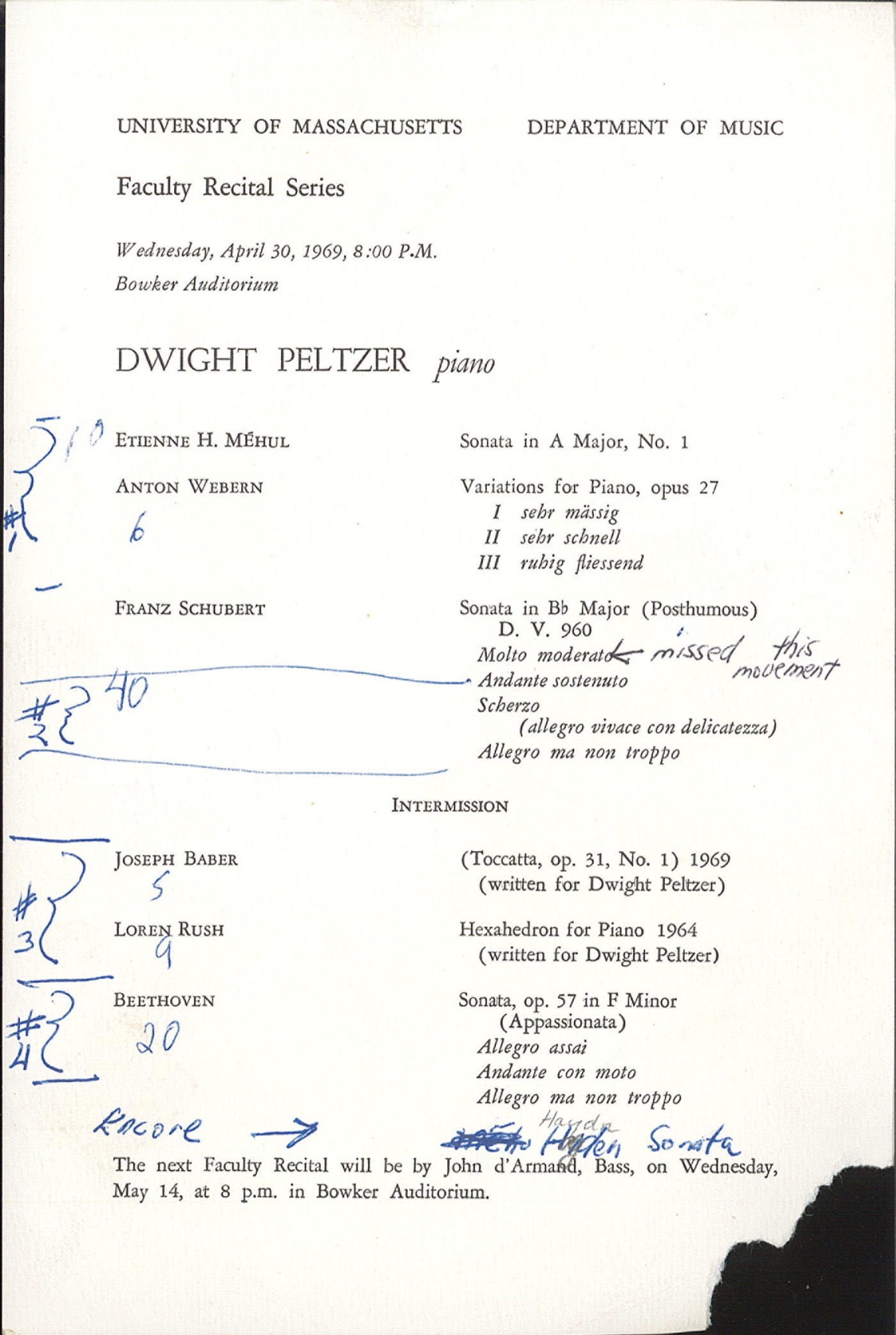
Wrote Hexahedron for Peltzer; performed beside him at Tudorfest; represented in The Contemporary Piano Project. With Peltzer he also co-founded the Performer’s Choice series in 1963 — “the moving force,” the Oakland Tribune called them. The same April 30, 1969 program marks Hexahedron “written for Dwight Peltzer,” and that performance is on the surviving tape.
Wrote Three Toccatas for Peltzer, heard him sight-read the work, and documented its premiere and touring life. The printed program of the April 30, 1969 UMass recital marks the Toccata “written for Dwight Peltzer,” and the WFCR tape of that evening survives — it can be heard here.
World premiere at Carnegie; wrote Found Objects No. 7 for Peltzer and embedded Peltzer’s piano sounds in its tape part. A second dedication surfaced in 2026: Rhapsodality Brown!, marked “written for Dwight Peltzer” on the November 1, 1970 UMass program, preserved on tape.
Peltzer gave the world premiere of 5 Poems for Piano at Carnegie Recital Hall.
Peltzer gave more than forty performances of Watts’s Piano Sonata by 1975, premiered Piano for Te Tutti in New York, and recorded the Sonata.
Peltzer performed and recorded Pentimento; the relationship is also part of the 2024 oral history.
Long-term close collaborator; Peltzer recorded Brehm in both The Contemporary Piano Project and Piano Piano Piano Piano.
Peltzer recorded Bestor’s Piano Sonata on Volume I of The Contemporary Piano Project.
Peltzer gave the New York premiere of the Piano Sonata, toured it in the United States and Europe, recorded it, and later recalled Thorne in oral history.
Peltzer premiered Chamber Concerto III with the Saint Paul Chamber Orchestra.
Wrote Time Into Pieces for Peltzer, who gave the first performance at UC San Diego.
Peltzer revived the Piano Concerto with Ozawa and the BSO and later discussed Martino in oral history.
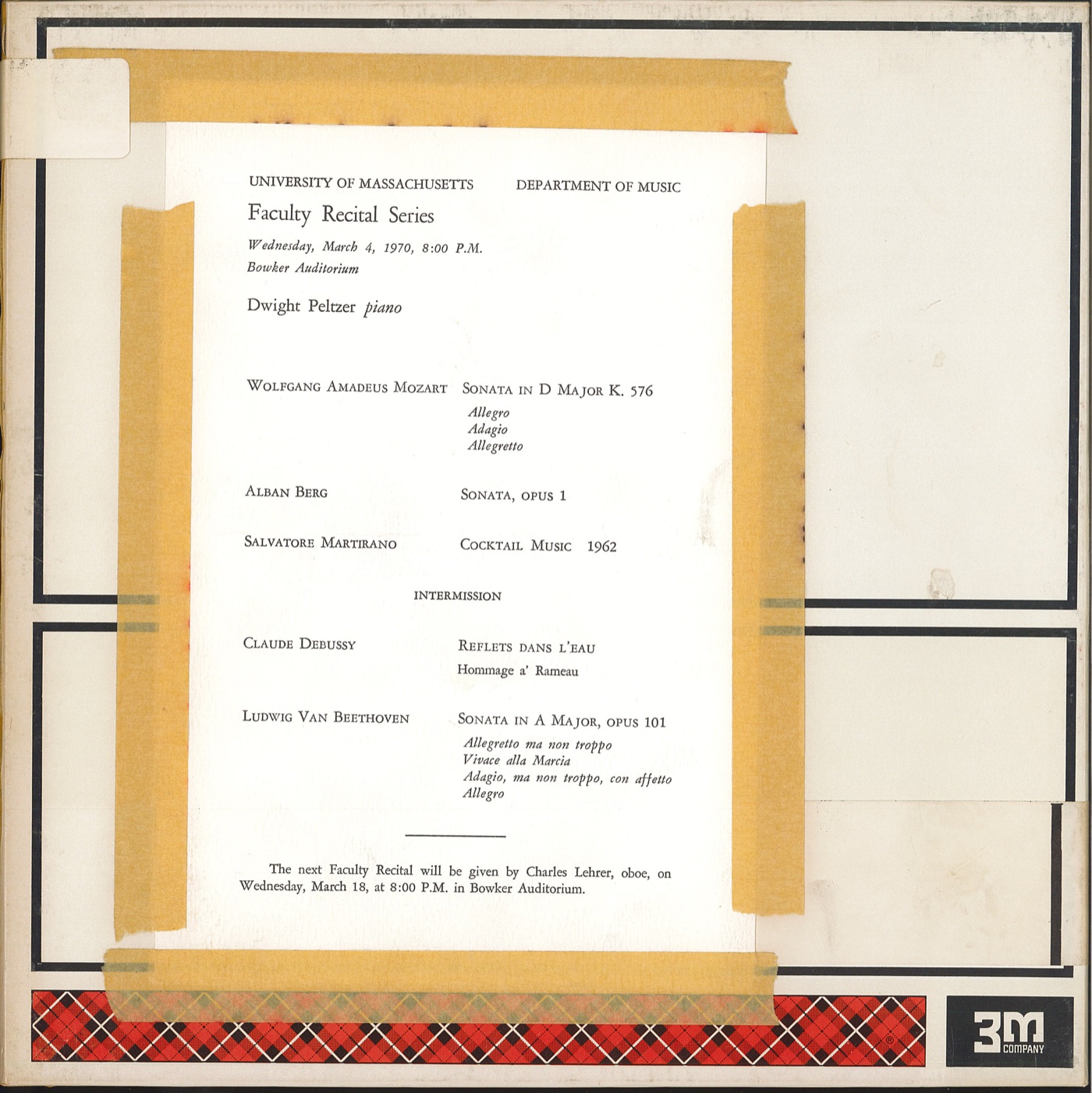
Cocktail Music was written for Peltzer, and the world premiere was his — Berkeley Little Theater, 25 February 1963, opening night of the Performer’s Choice series. A live Peltzer performance — March 4, 1970, at UMass — survives on a WFCR tape.
Composed the computer-assisted Fantasy Quintet for Peltzer as a National Endowment for the Arts commission.
Long-term collaborator whose Sestina Peltzer recorded for Serenus.
Wrote the Concerto for Piano and 7 Instruments “composed for pianist Dwight Peltzer.” Peltzer premiered it at Illinois and in the West, championed the Toccata “Ramus” from 1963 to 1966, and joined him for two television programs on improvisation.
Two works written for Peltzer: Innerkip, premiered at Alice Tully Hall in 1972, and And Bells—and Time, premiered at the Roxy Theater in St. Louis in 1968 — rain through the roof, a floor lamp for light.
His Variations for Piano was written for Peltzer, who carried it from San Francisco to St. Louis, the Philadelphia Museum of Art, and UMass — complete with a page-turner who “exited screaming” on cue.
His Ductia, Interlude and Jhala — from the Lou Harrison circle in Aptos — sat in the Goodwin–Peltzer two-piano programs of 1964.
Interlocutor in the March 4, 2024 filmed career conversation that supplies the oral-history layer of this edition.
Keele colleague and participant in the Princess Margaret recital; later chronicler of the department.
Student of Dwight Peltzer since 1988, collaborator, and friend. Creator of this archive.
Robert S. Cox Special Collections and University Archives Research Center: digitized the four WFCR faculty-recital reels of 1969–1970 that let this archive stream them.
Birth, first orchestral experience, European fellowships, major conductors remembered first-hand, international touring, and teaching begun alongside performance.
Dwight Peltzer is born on October 18, 1935, and grows up in rural Minnesota, where the piano becomes the central fact of his early life.
The exact birth date supplied for this living history gives the chronology its proper beginning. The later institutional biographies start with fellowships, venues, and appointments; the life itself starts in rural Minnesota.
Dwight’s first orchestral performance came at age twelve in Minneapolis, playing Beethoven’s First Piano Concerto as first prize winner in a young artist competition.
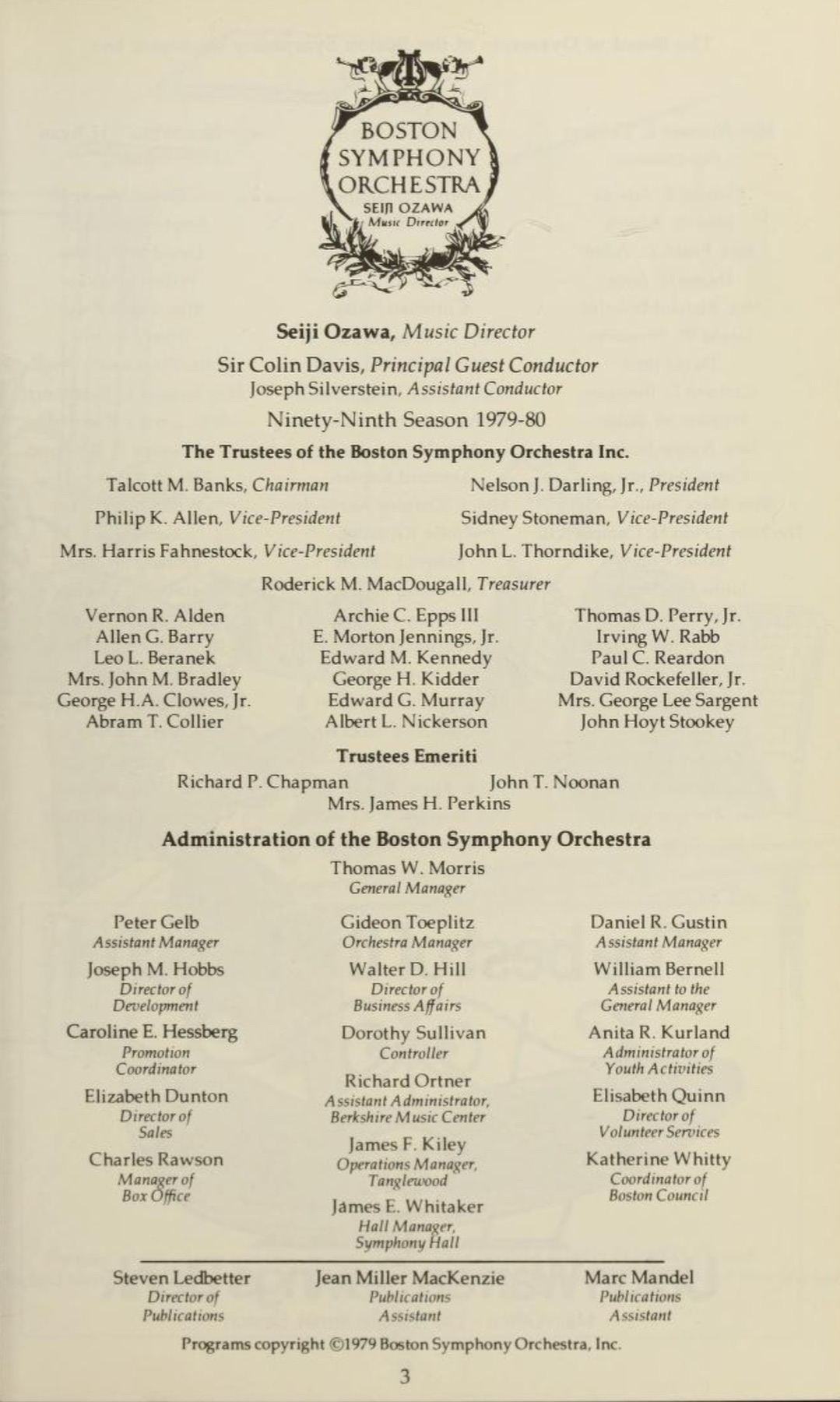
The Boston Symphony Orchestra’s program book of April 1980 states it plainly: “At age twelve, in Minneapolis, Minnesota, Dwight Peltzer performed Beethoven’s First Piano Concerto as first prize winner in a young artist competition.” That supersedes an earlier reading of this page. The competition prize, not the orchestra, is what the record names; the orchestra, conductor, and exact date remain open rather than guessed — and at age twelve the year is about 1947–48, a narrow enough window to search.
One supporting thread has since arrived from his own hand: his 1960 Berkeley teaching advertisement lists appearances “with Berlin Symphony, Vienna State Orchestra, Minneapolis Symphony.” Self-reported, and kept as such — but it is the first evidence beyond recollection that the young-artist orchestra was the Minneapolis Symphony.
Folkways liner notes identify two consecutive Fulbright fellowships: work with pianist Edwin Fischer in Switzerland and conductor-organist Karl Richter in Germany.
This is the traditional foundation behind the later contemporary-music reputation. Fischer represents a direct line into the central European piano tradition; Richter adds a conductor’s and organist’s view of structure, counterpoint, and ensemble.
In the 2024 conversation, Peltzer recalls Dimitri Mitropoulos as one of the conductors with whom he worked.
This edition accepts the first-person relationship as part of the career. It does not turn the recollection into a guessed program. The missing archival task is to identify the engagement; the relationship itself is not pushed back into an “unverified names” appendix.
Peltzer’s oral history includes Herbert von Karajan among the conductors with whom he worked.
The chronology places the relationship beside Peltzer’s European formation and early international circuit because that is the most plausible broad period, not because a specific engagement has yet been recovered. The purpose of the placement is to preserve memory without manufacturing precision.
Contemporary and retrospective biographies place Peltzer in solo, chamber, and orchestral appearances across North America and Europe, including major London halls and British festivals.
A 2023 profile says the pace sometimes exceeded two hundred concerts in a year and included appearances before royalty. That scale claim is retained as attributed recollection, not converted into an exact audited statistic. The broader point is secure: this was a substantial touring career.
Posts and residencies include the San Francisco Conservatory, Victoria School of Music, Philadelphia Musical Academy, the University of Illinois, and Southern Illinois University.
Teaching was not a late-career retreat from the stage. Workshops, residencies, master classes, and university appointments ran beside touring, commissioning, and recording. That parallel track becomes central to understanding the teacher Peltzer is today.
Peltzer enters the circle around David Tudor, John Cage, Pauline Oliveros, and the San Francisco Tape Music Center.
Pauline Oliveros, Ramon Sender, Morton Subotnick, and their circle build a musician-led home for electronic and experimental work.
The Center’s modest technology, artistic autonomy, and collaborative rehearsal culture made possible performances that more conventional institutions often resisted. Peltzer entered not as a tourist, but as a working member of that performance ecology.
Between the European years and the Fiedler debut, the record shows a musician working: a season-opening recital for the Santa Cruz Woman’s Club, a nightly cocktail-lounge engagement at the San Pablo Lucky Lanes, and programme teas for the East Bay women’s clubs.
The Santa Cruz recital of 28 September 1961 — Scarlatti and Mozart to Berg’s Op. 1 — drew a capacity crowd and a warm notice; three weeks later he opened “for an indefinite engagement” at a bowling-alley lounge, billed with his Berlin Symphony debut and twice-renewed Fulbright in the same paragraph. A tribute could omit this chapter; this archive keeps it. It is what the years between fellowships actually looked like on the ground, and the repertory — Berg beside Schumann for a women’s club — is the same argument he later carried to Hertz Hall.
Bartók’s Third Piano Concerto with the San Francisco Symphony under Arthur Fiedler — his San Francisco debut, at the Midsummer Pops of 11 August 1962. “An impressed Fiedler invited him back”: Brahms’s First, 24 July 1963.
The 1962 debut is among the best-documented events of his early career: a portrait in the Chronicle’s Pops photo spread, display advertisements — “POPS FINAL FIEDLER CONCERTS ... SAT., AUG. 11: Dwight Eugene Peltzer, Piano Soloist” — day-of listings with the full programme, and two reviews. “Peltzer and the orchestra under Fiedler brought it off successfully and were roundly acclaimed,” wrote Clifford Gessler. The next summer he returned — “his second appearance at the Pops” — for the Brahms D minor before a capacity house.
The 1980 Boston Symphony program bio dates the Fiedler association from 1961. The print record starts it in August 1962, and says so twice: “Peltzer ... made his San Francisco debut with the Pops last year, and an impressed Fiedler invited him back,” wrote the Chronicle in July 1963. The association is real; the year is off by one, and both are recorded here. Two small wrinkles are held as printed: the Berkeley Gazette places the 1962 concert at the Opera House where the San Francisco papers print the Civic Auditorium, and one 1963 review says “Tuesday night” where three listings say Wednesday.
With composer Loren Rush, Peltzer was “the moving force” behind Performer’s Choice, the KPFA-sponsored new-music series — and its opening night carried the world premiere of Martirano’s Cocktail Music and the first Bay Area performance of Boulez’s First Piano Sonata, both played by Peltzer.
“Peltzer will play first performances of Salvatore Martirano’s ‘Cocktail Music’ for piano and Boulez’ first piano sonata,” announced the Oakland Tribune; the Berkeley Gazette printed “world premiere.” Around him that night: Nathan Schwartz at the second piano, and John Chowning and Loren Rush on percussion. The series carried on — the West Coast premiere of Erickson’s concerto that May, the Cabrillo Bartók team at KPFA’s studio that October, Stockhausen’s Zyklus and Lou Harrison in January 1964 — much of it as live radio.
The Boulez thread deserves its own paragraph. Ten days after this concert he carried the First Sonata to the University of Illinois Festival of Contemporary Arts — the festival at which Boulez himself lectured the following week; whether Boulez heard him play is not established, and this archive does not guess. Ten years later he played the sonata for Boulez in person, and performed it at Studio 58 with the composer’s written good wishes. The advocacy began here, in a little theater in Berkeley.
Erickson’s Concerto for Piano and 7 Instruments was “composed for pianist Dwight Peltzer.” He gave the world premiere at the Festival of Contemporary Arts — Smith Music Hall, Saturday 9 March 1963, Jack McKenzie conducting — and the West Coast premiere that May under Gerhard Samuel.
The university’s printed program survives, and it is precise: the concerto appears with the credit “(Written for the 1963 Festival of Contemporary Arts),” its three movements marked FAST (piano cadenza), SLOW (group cadenza), and FINALE, with seven named Illinois players around Peltzer. Of the West Coast premiere, Alexander Fried heard “excitingly brilliant, even wild piano playing (including an avant-garde jam-session cadenza improvisation)”; Dean Wallace found it hard to believe “the excessive demands of virtuosity and musical cerebration” the score asked of Samuel, Peltzer, and “a hand-picked corps of veteran symphony musicians” — and called their response inspirational.
The festival weekend was bigger than one premiere. Two nights earlier, on 7 March, his guest recital carried Cocktail Music, the Webern Variationen, Erickson’s Toccata-Ramus, Ramon Sender’s Thrones for tape and piano, and Boulez’s First Sonata; on the 9th he also played Rush’s Mandala Music with the Illinois percussionists. Boulez himself lectured at the same festival the following week — whether he heard Peltzer play is not established, and this archive does not guess. The Erickson relationship ran on: the Toccata “Ramus” stayed his through 1966, and the two made a pair of KQED television programs — “The Performer as Improvisor” — discussing and playing the music together.
Peltzer played the opening concert of the very first Cabrillo Music Festival — Bartók’s Sonata for Two Pianos and Percussion with Joan Goodwin, Roland Kohloff, and Peggy Cunningham Lucchesi, Gerhard Samuel directing.
The Sentinel heard it “met by consecutive rounds of thunderous applause”; Dean Wallace called it “the definitive performance of this work,” and Peter Yates, in Arts and Architecture, “the best performance I have heard of Bartok’s powerful Sonata for Two Pianos and Percussion.” He returned for the 1964 season: Berg’s Chamber Concerto with Stanley Plummer, the Schubert Duo in A, Mozart’s “Ch’io mi scordi di te” with obbligato piano — and a place on the programme that premiered Lou Harrison’s Symphony on G. The festival became the Cabrillo Festival of Contemporary Music; he was there the night it began.
A seven-recital series, roughly monthly, setting Bach, Mozart, and late Beethoven beside Ives, Berg, Webern, Schoenberg, Krenek, and Martirano — “Dwight Peltzer, who is one of San Francisco’s finest pianists,” wrote Alfred Frankenstein of the opener.
The opener paired Bach’s C minor Partita and Beethoven’s Op. 109 with the Webern Variations and Cocktail Music; the second recital ended with what Frankenstein reported as San Francisco’s first public hearing of Ives’s Three-Page Sonata; the third set Schoenberg beside Ives’s First Sonata. He was Conservatory faculty at the time — “instructor at the San Francisco Conservatory,” in print.
This is the series the archive has been pointing at since its first edition without knowing it: Frankenstein’s Hertz Hall review of November 1964 praised the works “made familiar by Peltzer in his remarkable series of recitals last season at the San Francisco Conservatory.” The sentence now has its referent, dated programme by programme.
Martirano’s solo-piano work was written for Peltzer, and the world premiere was his: 25 February 1963, on the opening night of the Performer’s Choice series. He carried it for sixteen years, to the Purcell Room in 1979, where it was billed as a first London performance.
The premiere rests on two independent advance announcements — the Oakland Tribune’s “Peltzer will play first performances of Salvatore Martirano’s ‘Cocktail Music’” and the Berkeley Gazette’s “world premiere” — with a review two days later confirming the concert, “performed with devotion and skill, as this kind of music has to be.” Then the work travelled: his University of Illinois festival recital ten days later — 7 March 1963, in the university’s own printed program — the Mills College Milhaud Festival that May (“fresh and even exciting in its personal flourish and force” — Alexander Fried), the Conservatory series opener that November, Hertz Hall in 1964, Seattle — where the Times Colonist records it was “specially written by the Italian composer for the Victoria-based pianist” — three CBC broadcasts in 1965, St. Louis 1968, UMass 1970, Alice Tully Hall 1972, London 1979.
An earlier edition of this node dated the first documented performance to Seattle, October 1964, and left the premiere open; the Bay Area newspapers closed the question. This is the pattern of the whole career in one work: a composer writes him a difficult score, he gives the premiere, and he does not put it down.
Peltzer recalls working with Leonard Bernstein, not merely encountering his name through the New York Philharmonic’s modern-music history.
That distinction matters. The surrounding archive can explain Bernstein’s institutional role, but Peltzer’s oral history restores a direct professional relationship. This card preserves that fact while leaving the orchestra, work, and date open for later documentation.
A New York Philharmonic performance of Cage’s Atlas Eclipticalis met resistance from musicians and audience shortly before the same experimental language flourished at Tudorfest.
The contrast matters. Peltzer’s San Francisco performance took place inside a community prepared to rehearse, listen, and collaborate differently. The work was difficult, but the institution around it was not hostile to the premise.
Peltzer and David Tudor perform Cage’s paired duration scores; the surviving recording later becomes the opening work of New World Records’ archival set.
The recording log credits both pianists. The liner essay explains that Peltzer played 31′57.9864″ alongside Tudor’s 34′46.776″. A modern review hears not historical curiosity but precise control of attack, resonance, noise, density, and spatial separation.
Peltzer participates in Cage’s Music Walk and plays piano in Atlas Eclipticalis with Winter Music among central West Coast experimentalists.
The personnel include John Chowning, Stuart Dempster, Pauline Oliveros, Loren Rush, Morton Subotnick, Ramon Sender, David Tudor, and others. This places Peltzer inside a pivotal network of American experimental music, not at its edge.
Rush’s open-form piano work, written for Peltzer in 1963–64, receives its first performance.
The pianist chooses a path among contrasting musical events. That makes interpretation structural rather than decorative: Peltzer is not only executing a score but realizing its form in performance. The work later anchors Volume III of The Contemporary Piano Project.
Mozart, Baber, Marla Waterman, broadcasting, and the appointment that made Amherst a base for the next phase.
Following the Victoria Symphony Society’s annual meeting, Peltzer played Scarlatti, an Ives sonata, and an excerpt from Schumann’s Kinderszenen — reviewed twice the next morning.
Among the earliest documented Victoria appearances in the newspaper record, and already the shape of his programming: three centuries in one sitting, with Ives inside the frame rather than at its edge. It ties directly to the Ives performances preserved elsewhere on this site. Two reviews survive but no advance listing, so the occasion’s full programme is not recoverable — the reason this node sits at B.
John Emerson’s heart attack left Irma La Douce without its pianist mid-run. Jack Wasserman, in The Vancouver Sun: “Then 29-year-old Dwight Peltzer walked into the pit, opened the front page of the score and gave a downbeat.”
“The show came off rather well considering that Peltzer had never seen the score, or the show, until that instant.” It is the corpus’s single best illustration of a gift every colleague described independently — Joseph Baber expected a contemporary-music specialist and instead watched him read a complex new score at sight. Here the same faculty rescues a festival musical with a paying house in the seats.
With violinist Arthur Polson and cellist Hans Siegrist, Peltzer opened the Musical Art Society season — “the first resident, professional chamber music group that this city has ever had,” wrote Audrey St. D. Johnson.
The trio drew Victoria Symphony principals around the School of Music’s new head of piano, and the paper understood the institutional moment: a city acquiring its own professional chamber ensemble. The Times Colonist’s year-end column returned to the concert among 1964’s highlights.
Billed by the Victoria Daily Times — with a photograph — as his “First Solo Appearance On City Concert Stage”: Bach’s Partita No. 2 in C minor, Mozart’s K. 333, Berg’s Sonata Op. 1, and Beethoven’s “Appassionata.”
“Three centuries of music were embraced in his program,” wrote Audrey St. D. Johnson. The recital sits at the head of the Victoria solo career and is among the best-evidenced events in the whole newspaper corpus — billing, photograph, and review together. Berg’s Op. 1 placed between Mozart and Beethoven is the argument of this archive in a single evening.
The San Francisco Chronicle’s senior critic, reprinted under the heading “San Francisco Loses Pianist to Victoria”: “He has everything — dazzling technique, profound interpretative insight, and one of the best platform profiles since Stokowski’s heyday.”
The single best notice in the newspaper corpus, from one of the most respected American critics of his generation. Frankenstein was reviewing the Berkeley recitals that closed Peltzer’s San Francisco chapter; Vancouver reprinted the verdict as British Columbia claimed him. His original Chronicle review of the November 1964 Hertz Hall recital survives separately, in the clipping file Peltzer later mailed to Pierre Boulez.
A concerto appearance with the Victoria Symphony at the Royal Theatre — six independent records — with Beethoven’s Egmont Overture and Dvořák’s “New World” Symphony on the same programme.
“His fluent command of the keyboard makes light of prodigious difficulties ... his touch is not dry, in fact he produces a tone quality that is most pleasing,” wrote Audrey St. D. Johnson in the Times Colonist. Taken with the Mozart K. 414 of a month earlier at the McPherson Playhouse, it fixes what the Victoria years were: a working concerto soloist, engaged season by season, with twentieth-century repertory sitting naturally beside the classics.
A preserved broadcast presents Peltzer in Mozart’s Piano Concerto No. 12 in A major, K. 414, with the CBC Montreal Orchestra under Otto-Werner Mueller — the ensemble named by the tape’s own announcer.
K. 414 was the concerto of his Victoria years, and 1965 was its year. He played it live with the Victoria Symphony under Mueller at the opening of the McPherson Playhouse on 5 March 1965; in Montreal that June with the McGill University Chamber Orchestra — his first CBC Montreal engagement, after which, the Victoria paper reported, he was “immediately re-engaged by CBC for further broadcasts next winter,” and Mueller said “He played like an angel”; and on a CBC Strings broadcast that a printed CBC-FM schedule fixes at Monday 4 October 1965. He returned to the work at the University of Massachusetts on 16 December 1970.
For what the tape itself is, the announcer’s own words govern: he welcomes listeners to “concerts by the CBC Montreal Orchestra,” with Mueller as “our conductor this week.” That fits the re-engagement the Victoria paper reported — further Montreal broadcasts the following winter. The exact broadcast date remains under research, with the announcer’s present-tense references to Mueller’s Victoria post and Peltzer’s School of Music position bounding the window.
Peltzer performs Mozart’s E-flat major concerto, K. 482, with the CBC Vancouver Chamber Orchestra under John Avison.
This is the cleanest single rebuttal to the idea that he was only an avant-garde technician. The concerto requires classical proportion, ensemble flexibility, and long-line phrasing—abilities that later make his advocacy of new music more, not less, persuasive.
The Victoria Chamber Orchestra’s debut concert, a Christmas programme with Corelli and Bach: “At the four grands lined up across the stage, were Gertrude Durand, Winifred Scott, Dwight Peltzer and Robin Wood.”
Audrey St. D. Johnson’s headline called the debut significant and the group “a treasure.” The four-piano work itself is unnamed in print — the reason this node sits at B — but the image is worth keeping: four grands on one stage, three weeks before Christmas, with Peltzer among the city’s leading pianists.
On the departure recital — his only public performance in the Vancouver area: “What must be said of the entire recital, however, is that it ranked as an unqualified success. Lucky Philadelphia!”
Littler’s send-off marks the hinge between the British Columbia years and the Philadelphia Musical Academy. The programme itself made the case one more time — the Berg Sonata, Webern’s Variations, and Rush’s Hexahedron alongside the standard repertory — and the Vancouver Sun’s critic, not always an easy audience, called the whole an unqualified success.
The 2024 conversation places Pierre Boulez inside Peltzer’s working life.
The public catalog is not yet sufficient to attach a program or date. The oral-history evidence still changes the narrative: Boulez belongs in the network of people Peltzer actually encountered professionally, not only in a list of composers or conductors adjacent to his repertory.
Peltzer remembers working with composer and electronic-music pioneer Otto Luening.
The relationship is consistent with the larger career pattern—tape, electronics, composer-led institutions, and performer advocacy—but this edition does not use that consistency as a substitute for a program. It records the relationship and labels the metadata gap.
A Sunday-afternoon recital at the museum carried the world premiere of Arthur Custer’s Rhapsodality Brown, in a programme running from Mozart’s K. 333 to Philip Winsor’s Variations, closing with the “Appassionata” and a Haydn encore.
Samuel L. Singer of the Philadelphia Inquirer reviewed it — “one of the surprise delights of the season” — and recorded the theatrics of the Winsor, whose page-turner “exited screaming” on cue. Custer, like Peltzer, had been on the faculty of the Philadelphia Musical Academy.
The clipping carries no date, which is why this sits at B. Three bounds survive: the sheet was mailed to Boulez in February 1972; Peltzer performed the work at UMass on 1 November 1970 with the programme marking it “written for Dwight Peltzer”; and it stands on his 1972 repertory list. If the museum recital was the premiere, it precedes November 1970. The museum’s own Sunday-concert programme series would settle the date.
Peltzer accompanies soprano Marla Waterman in Baber songs while Baber begins writing a piano work for him.
The episode joins personal and professional history. Baber later remembered the collaboration continuing across decades, while the piano commission became a decisive example of a composer writing toward Peltzer’s particular combination of reading ability, tonal command, and appetite for difficulty.
Peltzer inaugurated a derelict neighbourhood movie house for the New Music Circle — rain dripping through the roof, an old floor lamp to light his music — and gave the world premiere of Peter Lewis’s And Bells—and Time.
Frank Peters in the St. Louis Post-Dispatch: “Dwight Peltzer, the steel-fingered young virtuoso of modern music, left a battered piano and ringing ears in the Roxy Theater last night ... As pianist, comedian and tragedian, Dwight Peltzer was great.” The programme ran from Ives and Satie to Erickson, Martirano, and Winsor, with violinist Myres Kartman of Southern Illinois University joining “in a last-hour change of plan.” The review places Peltzer as artist-in-residence at SIU — the residency that also produced the Baber Toccatas.
Joseph Baber wrote Three Toccatas, Op. 31 for Peltzer during their shared residency at Southern Illinois University. Baber records the premiere of the First Toccata as 9 May in Carbondale; the earliest documented performance is nine days earlier, at the University of Massachusetts on 30 April 1969.
Baber’s memory of the man is unusually revealing — he expected a contemporary-music specialist, heard Peltzer read a complex score at sight, and then discovered an equally serious command of eighteenth- and nineteenth-century repertory. That dual identity is the career in miniature. The Amherst review names the Toccata, with Rush’s Hexahedron, as “composed especially for this artist.” The two dates do not reconcile, and both are recorded here rather than one being quietly dropped; which performance was the first remains open.
Baber records that Peltzer took the First Toccata on tour after its premiere, playing it at the University of Chicago and the University of Massachusetts among other venues.
Baber also says the Amherst concert led to Peltzer’s appointment there. The contemporary record reads differently, and warmly enough: the documented Amherst performance of the Toccata was on 30 April 1969, and the review of it introduces Peltzer as an existing “new member of the University of Massachusetts music faculty” making “his public debut.” The appointment preceded the concert — he carried the new work to his new colleagues, not as an audition but as an arrival. The Chicago performance is undated and unlocated.
University records place Peltzer as Resident Artist in Music in 1970 and Assistant Professor of Music in 1971; he appears as UMass faculty from April 1969.
He was teaching from the spring of 1969: the review of his 30 April 1969 Bowker Auditorium recital introduces him as “a new member of the University of Massachusetts music faculty,” with the formal titles — Resident Artist in 1970, Assistant Professor in 1971 — following his arrival, as academic titles ordinarily do.
The university post becomes a base for faculty recitals, broadcasts, teaching, and touring. It is another reason the public record is fragmented: much of the work survives in local radio logs and institutional files rather than commercial releases.
Five members of the department in Mozart’s Quintet for piano and winds — “superior work,” wrote Wayne A. Smith in The Recorder, “marked by a proficiency in all phases of execution as well as warmth and mellowness of tone.”
The first documented chamber appearance of the UMass years, and a useful corrective to any reading of Peltzer as a specialist: within a single autumn he is premiering Baber, playing Mozart with wind principals, and preparing the broadcast recitals that WFCR would preserve.
A WFCR tape preserves an entire Peltzer recital — Méhul’s Sonata in A, Webern’s Op. 27 Variations, Schubert’s D. 960, Baber’s Toccata and Rush’s Hexahedron (both marked “written for Dwight Peltzer” on the program), and the Appassionata, with a Haydn encore.
This is the programming philosophy of the whole career on one evening: Webern beside Schubert, two works written for him beside Beethoven. The engineer’s pen preserved a loss as well — “missed this movement” beside the Schubert’s opening Molto moderato, which never made it to tape.
Peltzer partners percussionist Peter H. Tanner in Handel, Nielsen’s Op. 35, Moszkowski’s Spanish Dances, and Kreisler — the collaborative-pianist side of a faculty career, preserved on tape.
The repertoire is unglamorous and the role is service — which is exactly why it belongs in the record. Faculty life meant playing for colleagues as well as premiering for composers.
A second complete solo recital on tape: Mozart’s K. 576, Berg’s Sonata Op. 1, Salvatore Martirano’s Cocktail Music, two Debussy Images, and Beethoven’s Op. 101.
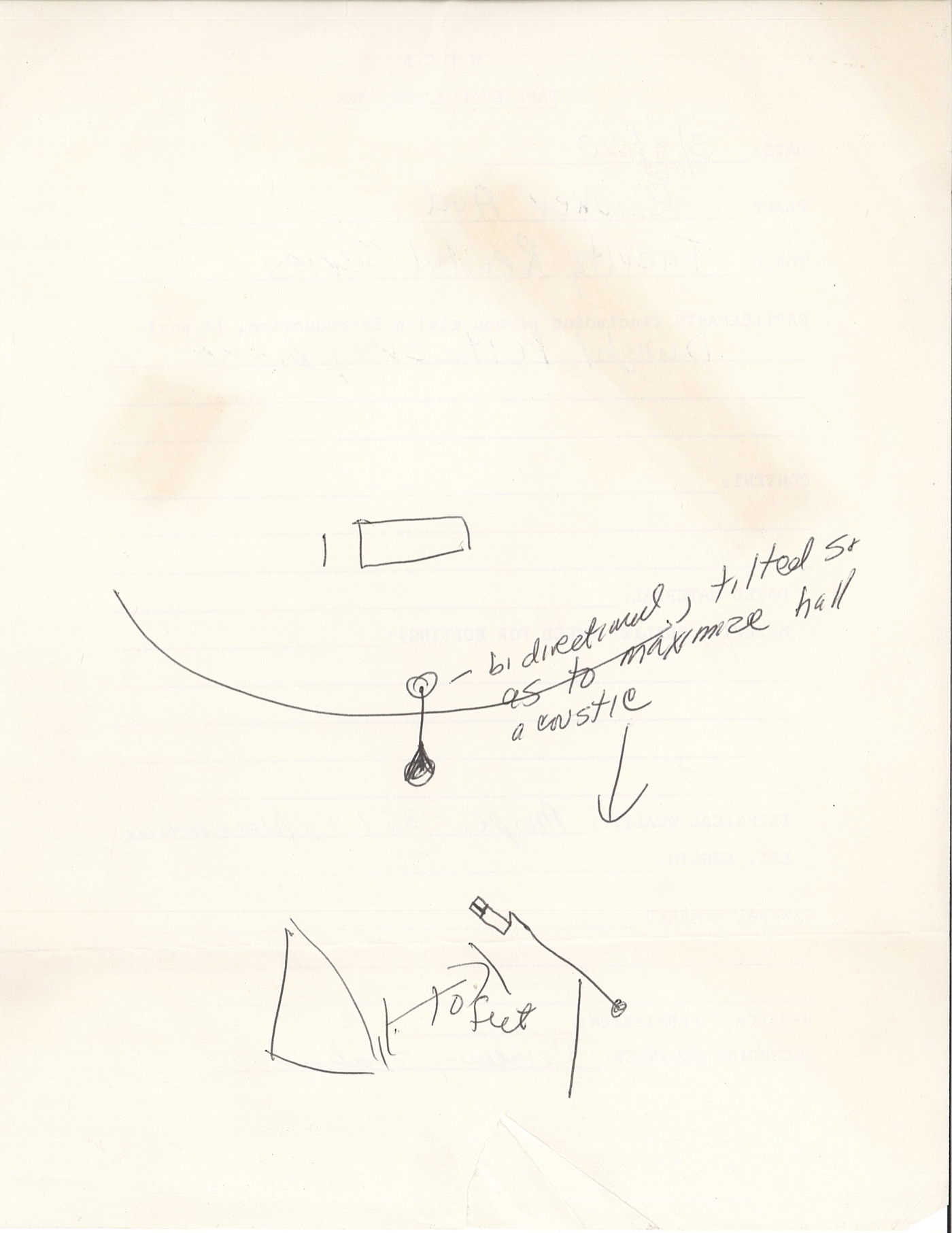
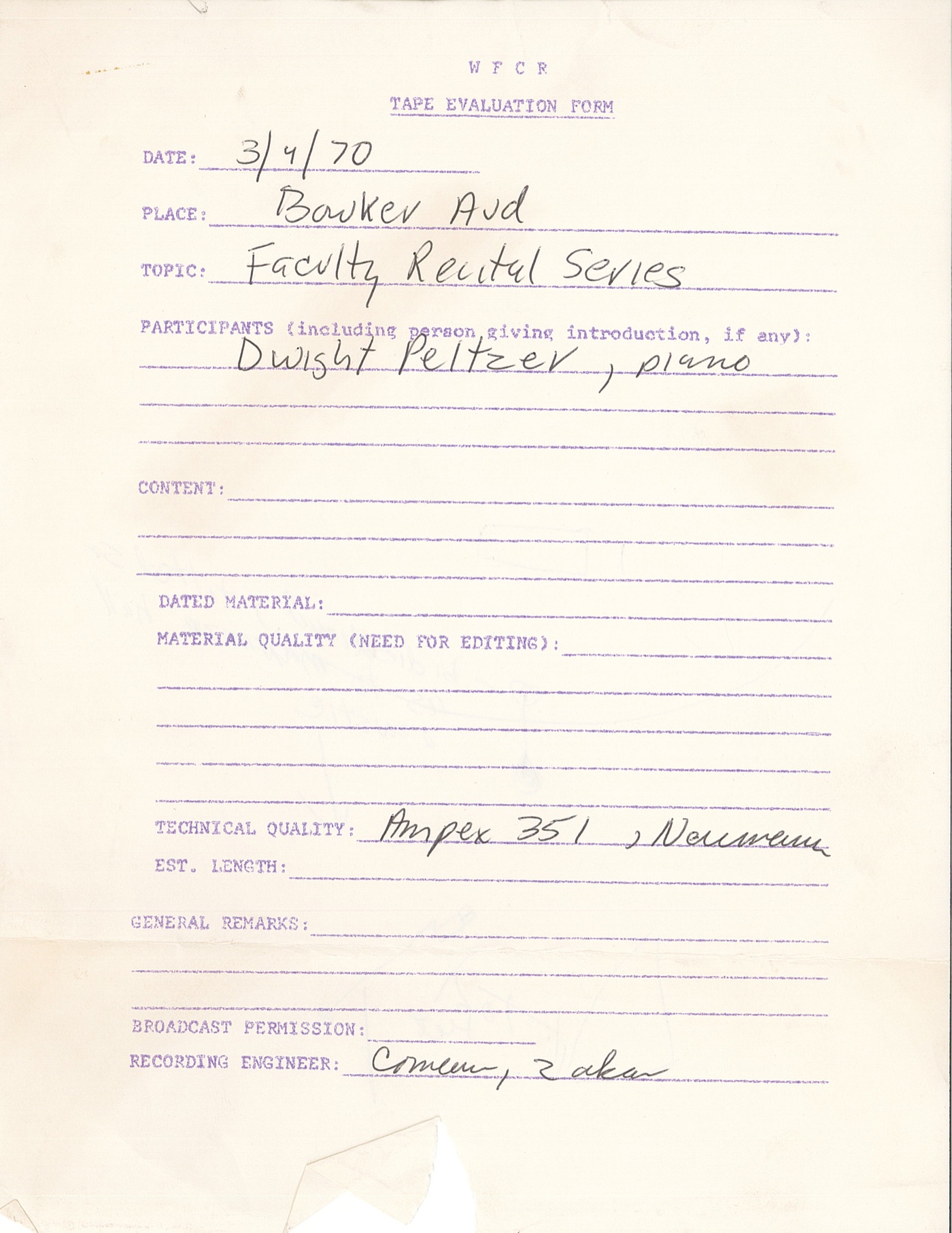
This tape holds a third distinct Peltzer recording of the Berg — his signature piece across three decades — and a live Cocktail Music, the Martirano work whose early performance history already runs through him. The WFCR log survives too: an Ampex 351 and a single Neumann bidirectional microphone, hung ten feet from the piano, “tilted so as to maximize hall acoustic.”
The duo recital: Ives’s Three-Page Sonata, Marla Waterman Peltzer singing Debussy’s Fêtes galantes and Berg’s Seven Early Songs, Arthur Custer’s Rhapsodality Brown! (“written for Dwight Peltzer”), and Beethoven’s Op. 110, with Peter H. Tanner assisting.
The only known recording of Dwight and Marla performing together — married the year before, colleagues on the same faculty, on the same stage. Her Berg songs with his piano are the emotional center of the UMass tapes.
In a concert of works by five area college composers: “a powerful, dynamic, and dramatic work. It was given a remarkable performance by Dwight Peltzer,” wrote Richard Conway in The Republican.
Tillis had joined the UMass faculty the year before; the notice shows Peltzer doing for a colleague in the Pioneer Valley exactly what he did for composers everywhere — carrying the new work in public, and being trusted with it first.
Carnegie, Composers Theatre, MoMA, Serenus, and a repertory built through repeated acts of trust.
Beethoven’s Diabelli Variations, prefaced by Peltzer’s own spoken guide to the styles inside the work — his third concert in three years for Hamilton and Kirkland audiences.
“Portraying ‘everything imaginable’ on a single, simple theme, concert pianist Dwight Peltzer overwhelmed the audience last night at Hamilton College’s Chapel,” wrote Charles Stogel in the Utica Daily Press. The Diabelli turns out to be the load-bearing work of 1971: Hamilton in February, Carnegie Recital Hall in May, and — by Peltzer’s own account — the performance Charles Wadsworth heard that led to the Martha Baird Rockefeller grant and the Alice Tully Hall debut. “His third concert in three years” also implies two earlier Hamilton appearances not yet found.
A solo recital places Beethoven’s Diabelli Variations and Berg’s Piano Sonata beside world premieres by Arthur Custer and Frederick Tillis.
This program destroys the false choice between standard repertory and modern advocacy. The Diabelli Variations demand monumental formal control; the premieres demand imagination without precedent. Peltzer put both responsibilities on the same evening.
A two-way correspondence preserved in Boulez’s own Philharmonic files — including a letter over Boulez’s signature, and Peltzer’s report of having played the First Sonata for the composer himself.
Peltzer wrote to Boulez in January 1972 to invite him to his Alice Tully Hall recital; Boulez was conducting that same evening. He wrote again asking to play for him, enclosing reviews and a two-page twentieth-century repertory list that included Boulez’s own First and Second Sonatas. Boulez’s secretary answered that he had read the material and “really tried very hard to find a time when he could see you, but it is humanly impossible.” The attempt ran another ten months — and then it happened. On 4 March 1973 Peltzer wrote: “It was a great privilige and pleasure to play your Sonata for you. I sincerely appreciated your helpful comments about the performance of the work.” Nine days later Boulez replied over his own signature: “May I wish you all the best for the concert of March 16 when you are playing my First Piano Sonata.”
Peltzer’s Lincoln Center solo debut, funded by a Martha Baird Rockefeller Grant: Martirano’s Cocktail Music, Haydn, a Peter Lewis premiere, Gaspard de la nuit, Beethoven’s Op. 110, and a Loren Rush premiere — on a Bösendorfer.
The printed handbill survives in the NY Phil Archives, and Donal Henahan reviewed the evening in The New York Times: “Not many pianists in any season take up recital programs as demanding as Dwight Peltzer’s at Alice Tully Hall Thursday night.” His verdict was mixed — the control praised, parts of the Ravel faulted — and it is quoted here as written.
One discrepancy is printed rather than reconciled: three primary sources disagree on which Rush work was premiered. Peltzer’s letter names Hexahedron; the handbill names A Little Traveling Music, “written for Dwight Peltzer — world premiere”; Henahan reports a Rush first performance and a New York — not world — premiere of Lewis’s Innerkip. All three survive, and the funding story is documented in Peltzer’s own letter: Charles Wadsworth heard him play the Diabelli Variations in May 1971 and recommended him to the Rockefeller Foundation; the grant came through that October.
Peltzer performs Boulez’s First Piano Sonata on the Concert Socials series, with chamber works alongside violist Karen Phillips and clarinetist Jerome Bunke — the concert Boulez himself wished him well for.
Two independent letters fix the date, time, venue, series, work, and collaborators — one of them from the composer: “May I wish you all the best for the concert of March 16 when you are playing my First Piano Sonata.” The programme also held Bruch’s Eight Pieces and the Vieuxtemps Viola Sonata. The same letter sketches a planned New York series with Boulez’s Second and Third Sonatas and Structures, Book 2, hoped for Alice Tully Hall; no evidence of its realisation has been found.
Peltzer’s 2024 oral history includes Lukas Foss among the artists with whom he worked.
Foss matters here not as a prestige name, but as another example of the porous world Peltzer occupied: composers conducted, performers taught, and new works moved through personal networks before they acquired an institutional history.
Ozawa’s long BSO tenure includes a sustained commitment to contemporary composers and creates the institutional setting for the Martino concerto revival.
The 1980 engagement was not an isolated act of eccentric programming. It belonged to a broader orchestral culture in which Ozawa repeatedly put difficult modern scores before a major audience.
Peltzer recalls a working relationship with Arthur Fiedler.
The Boston connection makes the recollection especially worth tracing, but the current source set does not yet establish whether the engagement involved the Boston Pops, another ensemble, chamber work, or a broadcast. The relationship is retained; the surrounding facts remain open.
Arthur Custer writes the work for Peltzer and builds the prerecorded tape component from Peltzer’s own piano sounds.
This is unusually literal evidence of the “composer’s pianist” idea. Peltzer is not only the interpreter after composition; his sonority becomes compositional material. The work later appears on The Contemporary Piano Project, Volume III.
Martino’s recognition establishes his standing in American modernism years before Peltzer and Ozawa return the long-dormant Piano Concerto to a major stage.
The concerto’s difficulty and long absence were not signs that its composer lacked stature. They show the opposite problem: even highly honored American modernism often lacked performers and institutions willing to sustain it.
Peltzer appears with the Composers Festival Orchestra during Composers Theatre’s sixth annual festival.
The exact work and day remain to be recovered, but the venue and role matter: he was not confined to university new-music series. He was a featured soloist in one of New York’s central concert complexes.
Programs and liner notes document Peltzer performing and recording Pleskow; the 2024 conversation restores Pleskow as a person in his working life.
The distinction is central to an oral-history edition. The paper record proves Pentimento and the MoMA appearances. Peltzer’s memory adds the human relationship through which repertoire was discussed, prepared, and carried into public life.
Peltzer performs with trumpeter Robert Levy and Watts on ARP synthesizer, including the New York premiere of Piano for Te Tutti and the Piano Sonata.
MoMA reports that Peltzer had already performed Watts’s Sonata more than forty times. That number changes the category: this was not premiere collecting. He was building a performance tradition for a work that otherwise did not have one.
The Times lists Peltzer with the clarinetist Jerome Bunke on WQXR’s live midnight series: Weber’s Concertino, a Wagner Adagio, and Bernstein’s Sonata.
This is Peltzer as a collaborative pianist, in clarinet repertory, on a national-calibre New York station — a side of the working life the archive had almost no printed record of. It also places him with Jerome Bunke for a second time: Bunke was the clarinettist of the Studio 58 concert of 16 March 1973 that Peltzer described in his own letter to Boulez. Two documented collaborations two years apart read as a working partnership rather than a booking.
Printed at the foot of Thursday, November 20, 1975: “12:06–1 A.M., WQXR: Artists in Concert. With Allen Weiss. (LIVE). Guests: Jerome Bunke and Dwight Peltzer. Concertino, Weber; Adagio, Wagner; Sonata, Bernstein.” The Times set the post-midnight hour at the end of the preceding evening’s block, so the broadcast went out in the small hours of Friday, November 21. The works are the standard clarinet-and-piano repertory of the period; Bernstein’s Sonata was his first published piece.
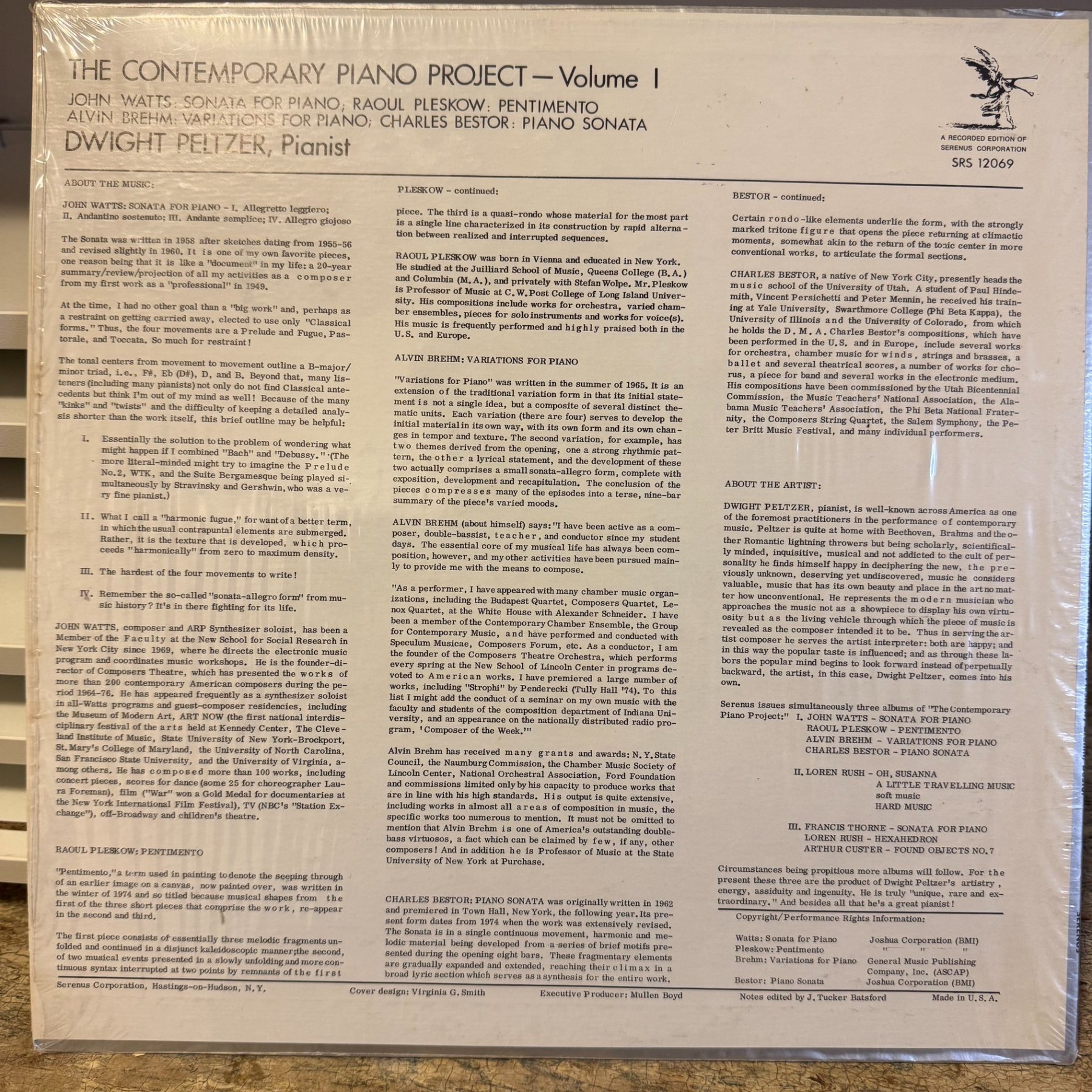
The series records works by John Watts, Raoul Pleskow, Alvin Brehm, Charles Bestor, Loren Rush, Francis Thorne, and Arthur Custer.
The newly supplied Volume I liner notes make the project’s philosophy explicit: Peltzer is presented not as a personality displaying virtuosity, but as the medium through which unfamiliar music becomes audible and intelligible. The back cover says all three volumes were issued simultaneously.
A complete live radio recital survives in program order: Gottschalk’s Bambula, Chopin’s First Ballade, Berg’s Piano Sonata, and Ravel’s Gaspard de la nuit.
The program matters because it lets the standard label “contemporary-music specialist” fall away in sound. The same pianist who premiered demanding American scores could sustain an imposing recital from Gottschalk through Ravel — live, without tape, at six minutes past midnight, on a studio piano the host apologises for on air. The announcer’s links and on-air biography survive with the music. The original tape ran about three percent fast and has been restored to pitch and tempo.
Artists in Concert was an hour of live music WQXR gave away at the end of the night — 12.06 to 1.00am, five nights a week, no tape and no concert hall. It began in a chance conversation at an Ardsley book fair between the businessman Michael Zinman and Walter Neiman, WQXR’s station manager, after WNCN-FM abandoned its classical format. Neiman had the midnight hour free. Zinman founded the non-profit Haydn Foundation for the Cultural Arts, bought a year of that hour at a cut rate of $20,000, and handed the program to the pianist Allen Weiss, who had two months to invent it and no experience in radio. “I wanted to avoid the illusion of talent night from Great Neck,” Weiss said. “I wanted the program to be something sophisticated, something important.” Within weeks it was booked solid, then booked five months ahead. Musicians paid their own expenses and took no fee; the audience reached Toronto and the Maine woods. Weiss stopped hosting in July 1976. Peltzer played the series at least twice.
The recital dates itself. Signing off, Weiss previews the nights ahead — Constance Cooper, and then the violinist the transcription hears as “the Walden Trio,” Yuval Waldman — and The New York Times places Cooper and Waldman on consecutive Artists in Concert listings for May 4 and May 5, 1976. Two named artists, previewed in order, on back-to-back nights of a series booked months ahead is not coincidence: it puts Peltzer in the WQXR studio on May 3. The Times prints Midnight with Music against May 3 itself, and gives Cooper a solo Ives program rather than the chamber group Weiss describes — but those listings went to press days ahead of a live series whose administrator kept the schedule deliberately unlocked, and the announcer speaking on the night outranks a schedule printed the Sunday before.
Peltzer’s recollection turns the documented Thorne Sonata history from a sequence of credits into a sustained composer-performer relationship.
The surviving record already shows premiere, touring, recital, and recording activity. Oral history supplies the narrative glue: Thorne was not simply a name on a program, but part of the professional world in which Peltzer repeatedly made new music audible.
Peltzer performs works by Aaron Copland, Raoul Pleskow, Alvin Brehm, Francis Thorne, Eugene Kurtz, and John Watts.
The program shows breadth inside “contemporary music” itself: established American modernism, composer-colleagues, serial and post-serial idioms, and music created for performer-led organizations. It also links the concert platform directly to the Serenus recording project.
Peltzer gives the New York premiere and subsequently tours the work on both sides of the Atlantic.
The important word is “subsequently.” Like Watts’s Sonata, Thorne’s work moved from event to repertory. Peltzer’s advocacy was cumulative: learn, premiere, repeat, record, and carry the piece into other musical communities.
Peltzer is piano soloist in the premiere, with William McGlaughlin conducting the Saint Paul Chamber Orchestra.
The engagement expands the pattern from solo recital and tape work to an established chamber orchestra. Composers trusted Peltzer not only to decode difficult notation, but to negotiate the social and acoustic complexity of a new concerto with an ensemble.
Corroboration arrived in 2026 from the published score: Chamber Concerto III (Carl Fischer, 1978) surfaces in HathiTrust’s full-text index on a search for Peltzer’s name — consistent with a printed premiere credit. The score’s front matter, and the exact 1977 date, remain to be obtained; the Saint Paul Chamber Orchestra’s own program archive would settle both. And the work itself survives in sound: in August 2026 the archive’s unidentified 14:10 Schwartz recording was identified as this concerto — an orchestra is audible around the piano.
A Fulbright-Hays year in which teaching, broadcasting, commissioning, festivals, London halls, and royalty coexist.
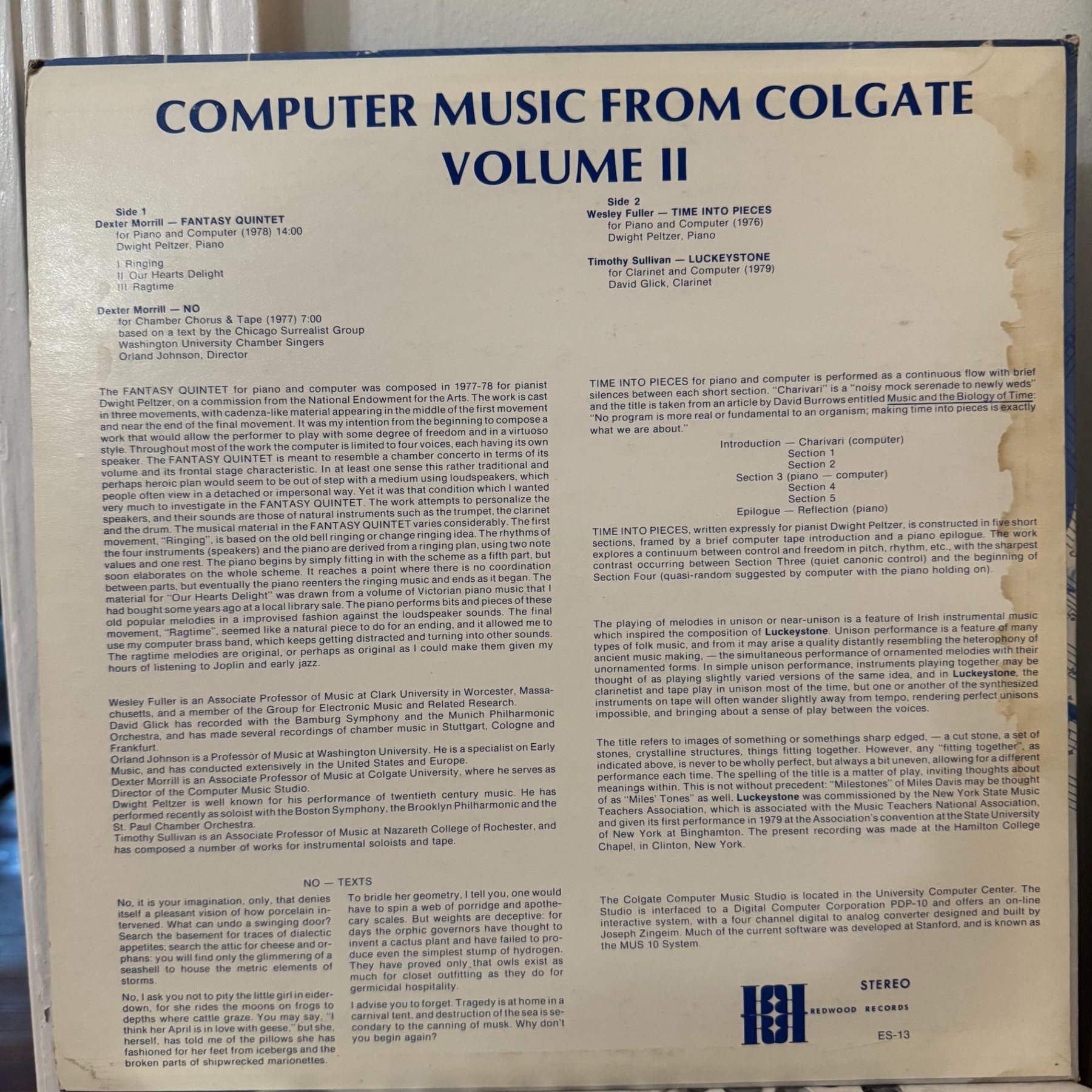
Morrill’s three-movement Fantasy Quintet for piano and computer was composed for Dwight Peltzer as a National Endowment for the Arts commission.
The jacket places Peltzer inside an early computer-music practice that asked a concert pianist to interact with virtual instrumental lines and prerecorded computer sound. The release and recording dates remain unresolved, but the work’s 1977–78 composition and its dedication to Peltzer are explicit.
Peltzer teaches American music history, harmonic analysis of ragtime, and complex twentieth-century repertory while maintaining a full performance and broadcast schedule.
The year is almost a career within the career: doctoral teaching, master classes, lecture-recitals, BBC recording, British commissions, London halls, festivals, and royal performance. Scholarship and stage work are not separated; each feeds the other.
Peltzer recalls premiering pieces written for him at the Edinburgh International Festival.
The accessible first-person account secures the event but does not name the works or date. They are therefore included as real premieres with unresolved metadata—not omitted, and not counted as exact-date records.
Five living American composers in one London evening — Ives, Morrill, Fuller, Watts, Rush — several works with quadraphonic tape, reviewed by Hugo Cole in The Guardian.
Cole described each work as it passed: Morrill’s Phantasy Quintet “included a rag and reminiscences of Victorian song”; Fuller’s Time Into Pieces was “more abstract and elaborate”; Watts’s Sonata “echoed Ravel in the first movement and Hindemith in a massive contrapuntal slow movement”; in Rush’s Oh Susannah, “the march from Mozart’s Figaro repeatedly loses its way, then regains energy.” The Guardian’s weekly music column listed Peltzer that week alongside Richter, Kentner, Biret, and Ian Hobson. Four of the five composers had written for him; the evening is also the evidence that redates Fuller’s work a year earlier than this edition once had it.
The United States–United Kingdom Educational Commission presents Peltzer in recital at Wigmore Hall.
Wigmore is a chamber-music proving ground, not a ceremonial résumé line. The appearance places his American-music advocacy inside one of London’s most exacting listening rooms.
Peltzer and the American pianist Cecil Lytle, his successor as visiting professor at Keele, gave a concert of American music in the Purcell Room, presented by English Chamber Orchestra & Music Society Ltd. within the GLC South Bank series.
The programme: Martirano’s Cocktail Music, a piano piece by Wilson, Crumb’s Five Pieces, Barber’s Sonata, the first performance of William Brooks’s Wall-paper Pieces, and a Scherzo by Coleridge-Taylor Perkinson. Four of the six were billed as first London performances.
The pairing makes the Fulbright mission concrete: American music exported not as one school or one personality but as a varied repertory carried by two musicians with different specialisms. Peltzer’s own 2021 memoir places this concert at Queen Elizabeth Hall, inside his Fulbright year, under Educational Commission auspices; seven contemporary London listings place it in the Purcell Room on 30 October 1979 — the following academic year — under a different presenter. The memoir is kept as memoir; the date, hall, and programme follow the contemporary record.
Peltzer travels to universities to teach American music and approaches to technically and analytically difficult twentieth-century scores.
This is where performance knowledge becomes pedagogy. He was not explaining new music from a textbook; he was teaching the analytical and physical decisions required to make it work in front of an audience.
On Barber’s Sonata Op. 26, at a recital of twentieth-century American music played and explained by Peltzer: “Peltzer gave this fine work a performance which built to heroic proportion.”
Grayson returned to the recital’s larger argument in a second notice the same day: “During this century the United States of America came of age musically and this fascinating concert of 20th century piano music, played and explained by Dwight Peltzer, offered examples of the development of a special American musical character.” It is as close as any contemporary critic came to stating the thesis of Peltzer’s British years — and of this archive.
Ten works in one evening — Ives, Martino, Rush, Bush, Crumb’s Five Pieces, Brehm’s Metamorphy, Barber’s Sonata Op. 26 — twice reviewed in the Evening Sentinel: the best-evidenced performance in the newspaper corpus.
“ADVOCACY of American music is an article of faith at Keele these days,” the review begins, and of the playing: “Dwight Peltzer played authoritatively and with considerable virtuosity in music as diverse in form and style as George Crumb’s five Piano Pieces and Samuel Barber’s sonata for piano Op. 26.” By the corpus’s own ranking this recital carries more independent documentary weight than any other single Peltzer performance — a named critic, two notices, and a ten-work programme recoverable in full.
Peltzer records programs and interviews devoted to American music; contemporary notes also mention a planned Samuel Barber seventieth-birthday program.
The broadcasts could be among the richest surviving records of his musical thinking, but transmission dates and audio remain to be recovered from BBC Written Archives. Their existence shows that he was trusted as an explainer as well as a performer.
The 1981 Folkways biography lists Peltzer among Cheltenham Festival performers during the broader British period.
The exact program and date remain open, but the festival credit is part of a consistent cluster of first-party and contemporary biographical evidence, not an isolated internet claim.
Peltzer, Marla Waterman, and Peter Dickinson perform for Princess Margaret, Chancellor of Keele; Peltzer recognizes her sung request as a Scott Joplin rag.
The anecdote is charming because it compresses the year’s range: analytical teaching of ragtime, new British commissions, BBC modernism, London recitals, and Joplin for royalty. None of those activities sits outside his idea of serious musicianship.
A major-orchestra culmination, chamber recording, computer music, and critical recognition.
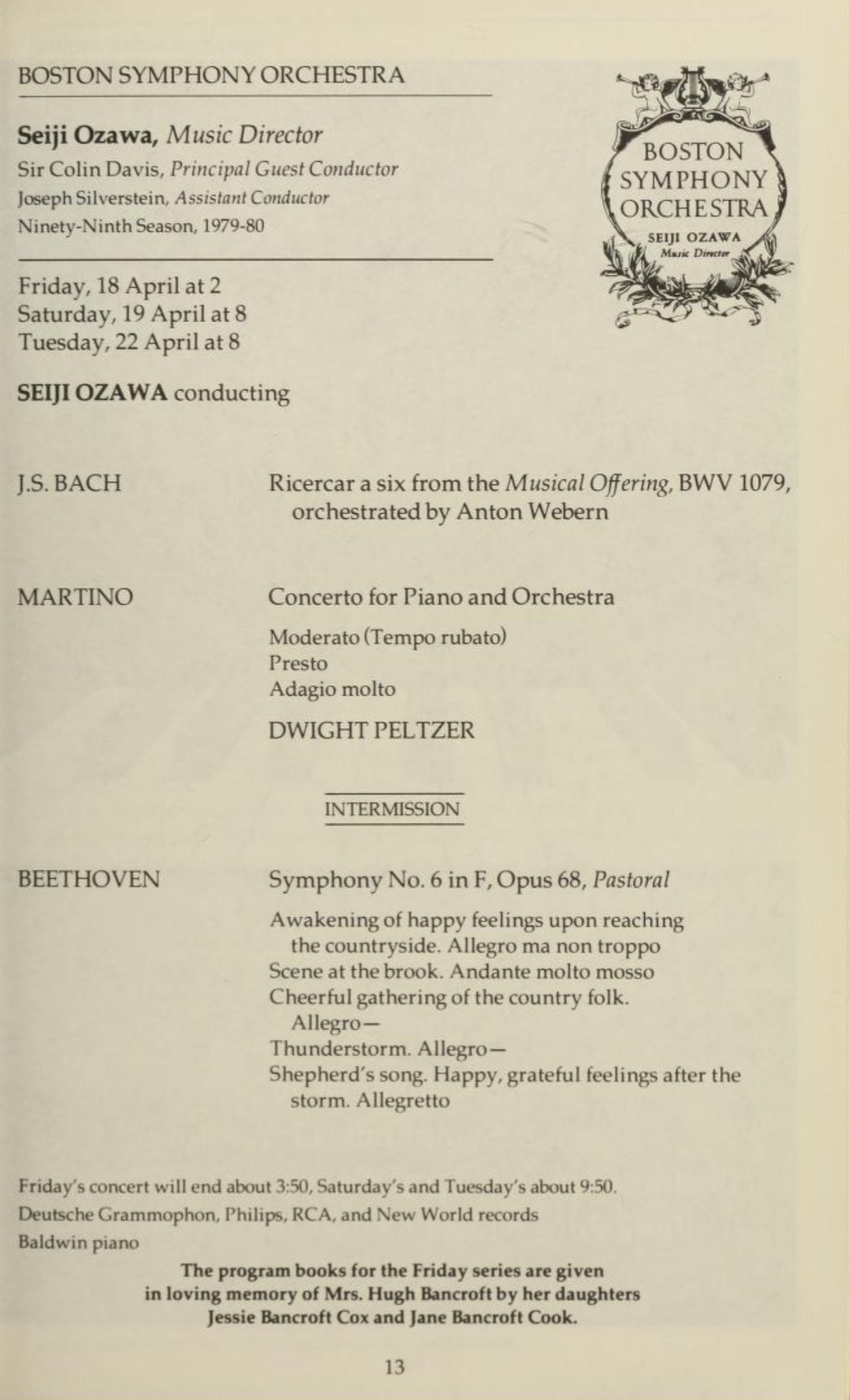
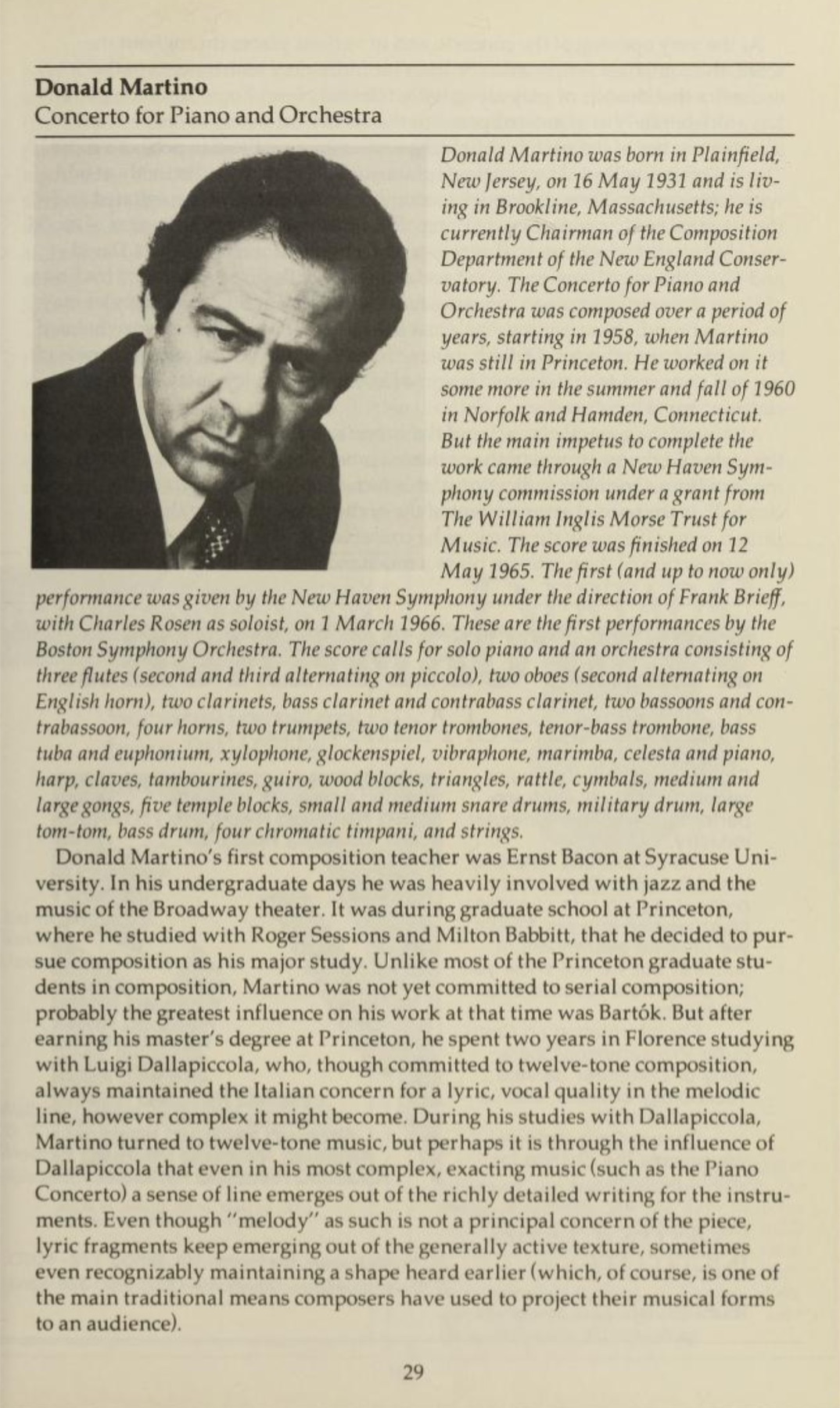
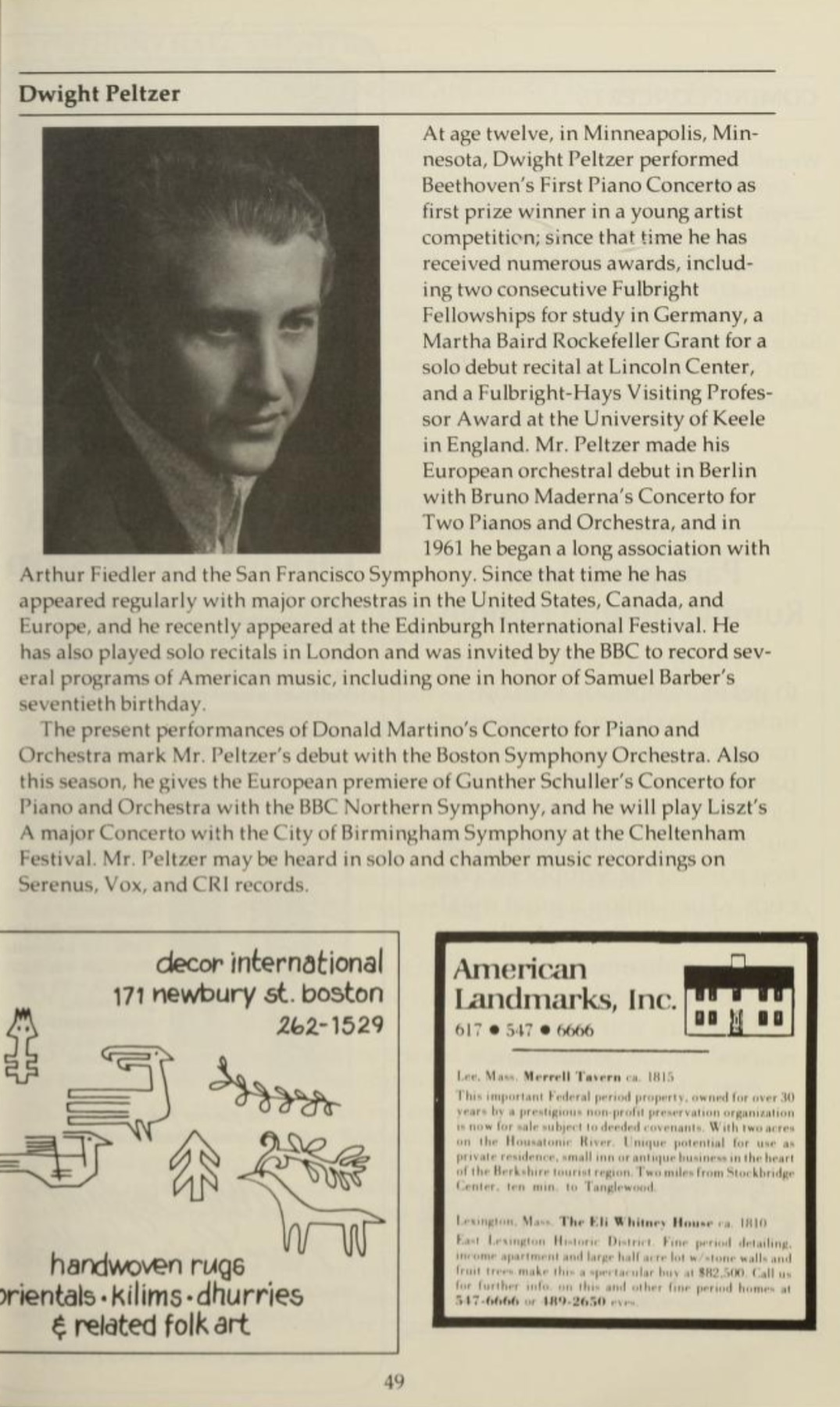
Peltzer made his Boston Symphony debut in three subscription concerts under Seiji Ozawa — only the second-ever performances of Martino’s Piano Concerto, and the orchestra’s first, paired with Beethoven’s “Pastoral.”
This was not an isolated adventure. It is the major-orchestra culmination of a career spent making difficult American scores credible. The concerto had waited since its only previous outing — Charles Rosen with the New Haven Symphony under Frank Brieff, 1 March 1966 — and Peltzer supplied both the technique and the advocacy required to bring it back. The program book states it plainly: these were the first performances by the Boston Symphony Orchestra, and “the present performances ... mark Mr. Peltzer’s debut with the Boston Symphony Orchestra.”
The engagement was first announced for 15–17 March 1979 — an English paper carried it in June 1978, and a Massachusetts listings column printed the dates and the same “Pastoral” pairing in February 1979 — and was postponed; March 1979 fell inside his Fulbright year at Keele. The performances came thirteen months later. His 2024 conversation with Leonard Lehrman adds the remembered human relationship with Ozawa and Martino to the dates preserved by the orchestra and press.
Hear the work in a preserved live performance
The program book, page by page: the program page · the first-performances note · the Martino note · continued · concluded · the Peltzer biography · the season title page
Boston Symphony season materials schedule Peltzer for a Monday-morning Morning Pro Musica appearance between the Symphony Hall performances.
The broadcast is a high-value archive target because it may preserve Peltzer speaking about Martino, Ozawa, and the concerto in real time rather than decades later. The audio has not yet been located online.
Larry Katz praises Peltzer’s skill and conviction; the Christian Science Monitor treats him as the kind of fierce advocate a difficult concerto needs.
The reviews matter less as résumé praise than as evidence of role. The critics may debate the concerto, but they recognize that Peltzer does more than survive it: he makes the strongest possible argument for it.
With violinist David Sackson, Peltzer records Cowell’s Suite, Hymn and Fuguing Tune No. 16, and Violin Sonata for Folkways.
The album reveals another modernism: lyrical chamber playing, folk and hymn inflection, contrapuntal clarity, and classical form rather than experimental effect alone. It is probably the best readily available recording for hearing the breadth of his musicianship.
Fuller wrote the electroacoustic work for Peltzer. The earliest documented performance is at Riverside Studios in London on 1 April 1979, in an evening of American piano music with quadraphonic tape reviewed by Hugo Cole in The Guardian.
The work extends the tape-and-piano experience of Custer and Tudorfest into computer music. Once again a composer builds a piece around Peltzer’s willingness to solve new technical and temporal problems in public. This edition previously gave a first performance at UC San Diego in 1980; the London evidence predates that by a year, so the premiere is recorded here as unresolved rather than reconciled.
Steinway lists Peltzer as an artist since 1980.
His own Steinway statement invokes the most delicate colors in Ravel and Chopin as well as power in Brahms, Liszt, and Rachmaninoff. That self-description matters: the pianist did not understand his identity as “new music only.”
Peltzer records six of Luening’s compact piano sonatas on a Serenus release that explicitly situates him beside the 1980 Martino–Ozawa Boston engagement.
The jacket’s period appraisal is unusually direct: Serenus says Peltzer was considered one of the best new-music pianists because he was “one of the best pianists, period.” The album also converts an oral-history relationship with Luening into a documented recorded collaboration.
Peltzer records Rudhyar’s piano music and Weigl’s Night Fantasies, extending the Serenus catalog beyond The Contemporary Piano Project.
The pairing is revealing: two composers with very different languages and historical positions. It supports the idea that Peltzer’s recording choices were acts of recovery as much as documentation of current work.
A Serenus LP pairs Peltzer’s recording of Ornstein’s Gnome Suite with music by Alexei Haieff.
The Ornstein discography identifies it as the only known commercial recording of the work. That is a recurring feature of Peltzer’s legacy: some of the repertory survives at all because he recorded it.
Peltzer is the pianist in a complete Pierrot Lunaire, Op. 21, recorded by Joel Thome’s Orchestra of Our Time and issued by Vox alongside Dallapiccola, Crumb, and Boulez.
Almost everything else in this chronology places Peltzer inside American music. This does not. Pierrot Lunaire is the pivot of European modernism, and its pianist is the ensemble’s spine — holding the chamber texture steady beneath a singer who is neither speaking nor singing. He is doing there, in the core canon, exactly what the American composers hired him to do in theirs.
The ensemble is Orchestra of Our Time under Joel Thome, with Maureen McNalley in the Sprechstimme, Sue Ann Kahn on flute, Anand Devendra on clarinet, Eric Rosenblith on violin, and Chris Finckel on cello. The performance runs 36:45.
The date is unresolved. 1995 is the Vox CD issue and 2008 the digital reissue; Orchestra of Our Time was active from the mid-1970s, so the recording itself is almost certainly older than its release. It is placed here by release, not by performance.
Peltzer and his wife, soprano Marla, gave “repeat performances” at the Zabriskie House annual Open House — the latest documented public performance in the entire newspaper record.
The record that opens with a five-year-old playing “Merry Christmas” at the Brainerd Gospel Tabernacle on 20 December 1940 closes, forty-six years later, at another small-town Christmas concert. The word “repeat” means he had played the Open House in earlier years, so earlier Wyckoff appearances almost certainly await finding; and the paper prints his wife as “soprano Marla Peltzer,” her married name — the singer this site knows throughout as Marla Waterman. The item also brackets the site’s account of focal dystonia ending his concert career: whatever the transition was, it began no earlier than December 1986.
The archival recovery of old performances, Peltzer’s own recollections, and the living continuation of the tradition.
In his late sixties, Peltzer taught himself computer science, joined the faculty at LIU Post, and wrote two books on enterprise software architecture.
In 1964 he sat at one of two pianos in San Francisco and read John Cage’s indeterminate graphic scores beside David Tudor. In 2003 he wrote the manual for making two incompatible enterprise platforms speak to each other. It is the same problem — two systems that do not share a language, and someone patient enough to find the one they can both be made to keep.
The books are .NET & J2EE Interoperability (McGraw-Hill/Osborne, 2003), written for the moment when corporate computing had split into two hostile camps and needed a bridge, and XML: Language Mechanics and Applications (Addison-Wesley, 2004). The first was technically reviewed by engineers from both Microsoft and Sun — the two companies whose platforms it was teaching to cooperate.
He also became the kind of colleague people write books because of. Steven Heim’s The Resonant Interface, a standard text on human-computer interaction, opens its acknowledgments this way: “I owe a special debt of gratitude to my dear friend and colleague Dwight Peltzer, without whom this project never would have even begun; Dwight, thank you for everything.”
The pianist who spent a career learning other people’s impossible scores had, at sixty-eight, simply gone and learned another one.
A three-disc archival set restores Peltzer’s performances to the documented history of American experimental music fifty years later.
The release turns ephemeral events into a durable listening record. It also demonstrates why web biographies can mislead: a central historical performance may remain commercially invisible for half a century.
Apple Music · Spotify · Amazon
The essay preserves teaching, BBC recording, British commissions, London performances, festivals, and the Princess Margaret episode in Peltzer’s own voice.
It is one of the most important sources because it records what Peltzer himself considered memorable. Programs tell us what happened; memoir tells us which experiences remained alive and why.
Peltzer and composer-pianist Leonard Lehrman discuss the composers, conductors, performers, and institutions that formed Peltzer’s working life.
This is not merely a late event to append to the timeline. It is a source that runs backward through the entire chronology. The names include Ozawa, Martino, Bernstein, Boulez, Karajan, Foss, Luening, Fiedler, Mitropoulos, Pleskow, and Thorne. This edition accepts those first-person relationships and places them approximately where they belong.
Focal dystonia in the left hand ended Peltzer’s ability to concertize at the professional level; the performing tradition continued through teaching.
Dwight has explained that the extraordinary and sustained preparation required by Donald Martino’s concerto may have contributed to or accelerated task-specific focal dystonia in his left hand. The condition disrupts fine motor control during the highly practiced task itself; it is neurological, not a failure of discipline or technique. Teaching was not a fallback or a late invention—it had run alongside the concert career for decades. Once professional concertizing became impossible, however, the studio became the principal arena in which he transmitted that experience. The parallel with pianist Leon Fleisher is instructive: focal dystonia redirected Fleisher toward left-hand repertory, conducting, and an extraordinary teaching life. Dwight’s students receive the accumulated solutions of Fischer, Richter, Tudor, Ozawa, Martino, and decades of work with living composers—at the keyboard, one lesson at a time.
About musician’s focal dystonia · Leon Fleisher’s public record
Twenty-one recordings. Eighteen—just over seven hours—were recovered from analog tape and never commercially released. Two sources identify themselves on the air, and those announcements are preserved and transcribed here. Other recordings remain partly unidentified and invite informed listening. Four complete faculty recitals, digitized from the original WFCR reels in 2026 by the University of Massachusetts Amherst, stream here by courtesy of the university’s Special Collections. Three commercially released albums, which are not part of this archive, are listed at the end with links to Apple Music, Spotify, and Amazon.
Restoration note. The Artists in Concert tape ran about three percent fast—a quarter-tone sharp. All four tracks were speed-corrected together, restoring pitch and tempo without compression or limiting. The web files are 192 kbps AAC and loudness-normalized by linear gain only; lossless masters remain in the private archive. The four UMass concerts were transferred from the original reels in 2026 by Jeremy Smith of the Robert S. Cox Special Collections & University Archives Research Center; they stream here by courtesy of UMass Amherst Libraries and are not offered for download.
Dwight Peltzer, piano · live radio recital · WQXR, New York · Haydn Foundation for the Cultural Arts · host Allen Weiss · broadcast live, 12.06–1.00am, May 3, 1976. Program order and announcer links are preserved.
Artists in Concert · WQXR · Haydn Foundation for the Cultural Arts · host Allen Weiss
In Concert, a series of live radio concerts brought to you by the Haydn Foundation for the Cultural Arts, featuring noted concert artists in solo and chamber recitals. And here to introduce tonight’s program is your host, Allen Weiss.
Good evening. Tonight’s artist in concert is Dwight Peltzer, pianist, and we’ll hear a program of Gottschalk, Chopin, Berg, and Ravel—the Bambula by Gottschalk, the Ballade in G minor number one by Chopin, the Alban Berg Sonata Opus One, and the Gaspard de la Nuit of Ravel.
And those of you who are pianists in the audience, or who know your literature, know that this is an imposing program for a concert hall, with rests and breaks—and Mr. Peltzer is going to perform it on our resident instrument, which as you know is not the easiest one to perform. I consider this program a sheer feat of prestidigitation, as it were, but he sounds marvelous and it’s going to be all right.
I just want to say, to the letters coming in about the pianos, that we are in the process of changing and repairing and so forth, and pretty soon this whole episode shall be behind us. But he is game, and we will proceed with the Gottschalk Bambula.
Artists in Concert · WQXR · announcer links preserved
And we will now have the—well, I’m not letting you up so soon—the Chopin Ballade in G minor.
…with the Rhode Island State Council for the Arts. He was the recipient of the grant from the Martha Baird Rockefeller Fund for the recital at Lincoln Center, and attracted attention in musical educational circles with Explorations, a program of workshops and performances on college campuses throughout the United States. Mr. Peltzer is currently recording a series of solo discs of contemporary American music for Serenus Records, and next season Mr. Peltzer will be performing in England, and will premiere a piano concerto by John Watts on the Composers Theatre series at Lincoln Center.
Artists in Concert · WQXR · announcer link preserved
…the Alban Berg Sonata, Opus One, performed by Dwight Peltzer. [I have always] wished that Berg had gotten around to a few more of those sonatas. Such a beautiful work.
Artists in Concert · WQXR · program close preserved
This sign-off is what dates the recital. The artists Weiss previews for the following nights — Constance Cooper, and the violinist the transcription hears as “the Walden Trio,” Yuval Waldman — appear on consecutive Artists in Concert listings in The New York Times for May 4 and May 5, 1976, which places this broadcast on May 3. The transcript is left as heard.
…pianists always show up at places to play concerts, and they try the pianos, and then they have heart failure, and then they’re informed, “well, wait till you see the one we’re getting next week.” That doesn’t help.
Anyway—I thank you, and ask our audience to join us again tomorrow evening, when Constance Cooper, Dan Butterfield, and Andre Smith [names uncertain] perform works of Stravinsky, [Janáček?], Butterfield, and Prokofiev; Thursday, the Walden Trio; and Friday, pianist Louis [surname unclear]. Thank you, and good night.
You’ve been listening to Artists in Concert, a new series of live radio concerts brought to you by the Haydn Foundation. Your host, Allen Weiss.
Dwight Peltzer, piano · Mozart K. 414 with Otto-Werner Mueller and the CBC Montreal Orchestra. The announcer’s present-tense references date the broadcast to c. 1963–67, most likely 1963–65.
CBC Montreal Orchestra · Otto-Werner Mueller, conductor · host John Trethewey
Dated by the announcer’s present-tense references to the Victoria Symphony and Victoria School of Music.
Opening: Ladies and gentlemen, this is your host, John Trethewey [name uncertain], inviting you to join us for concerts by the CBC Montreal Orchestra. Our conductor this week is Otto-Werner Mueller, permanent conductor of the Victoria Symphony Orchestra.
The main work to be heard this week is Mozart’s Concerto for piano and orchestra in A major, Köchel 414. It will be performed by the distinguished American pianist Dwight Peltzer, head of the piano department at the Victoria School of Music in British Columbia. Here is Mozart’s Concerto in A major, Köchel 414. The movements are marked Allegro, Andante, and the finale Allegretto.
Close: The second movement from Elgar’s Serenade for Strings brings to a close this week’s concert by the CBC Montreal Orchestra under the baton of Otto-Werner Mueller. The main work was Mozart’s Concerto in A major, Köchel 414, which was performed by pianist Dwight Peltzer. Technical operations, Claude Morin. Production, Lawrence Taylor. This is your host John Trethewey, inviting you to join us next week at this time, when Laszlo Gati will lead the orchestra in a program of Swedish music.
Dwight Peltzer, piano, with orchestra · three movements, 22:41 total. Identified in August 2026 as Wilhelm Friedemann Bach’s Keyboard Concerto in E minor — the eldest Bach son, not Johann Sebastian, which is why no BWV ever fitted. The work carries no opus number; it is catalogued as F. 43 (Falck), sometimes written Fk. 43. A contemporary CBC listing in the Ottawa Citizen of 12 August 1964 independently prints the composer as “W. F. Bach,” corroborating the attribution from the period itself. The orchestra and conductor remain unnamed on the disc.
Archive disc · no announcer
The handwritten labels give only “BACH E MINOR” and the movement order. An orchestra plays in all three movements — confirmed by ear, August 2026 — so this is a concerto rather than a solo work. In August 2026 the work was identified as Wilhelm Friedemann Bach’s Keyboard Concerto in E minor, F. 43; a CBC listing in the Ottawa Citizen of 12 August 1964 prints the composer as “W. F. Bach”, corroborating it from the period. The first movement runs 6:44; the second, 10:43, moves in an A minor / C major orbit and ends in A minor; the third is faster and thinner over a low E pedal. Neither the orchestra nor the conductor is named on the labels. There is no BWV because this is not a work of Johann Sebastian’s; the Falck catalogue number is F. 43. If you can name the orchestra or conductor, please write.
Dwight Peltzer, piano · a heterogeneous set rather than a single program: Weigl, Schwartz, Martino, Berg, and Watts. Source, venue, and date remain unknown unless stated.
On the Weigl: Nachtphantasien is published as five pieces, and this transfer preserves four tracks. One piece may be missing from the transfer, or two may run together in a single track.
Archive disc · source, venue, and date unknown
Archive disc · source, venue, and date unknown
Archive disc · source, venue, and date unknown
Archive disc · source, venue, and date unknown
Archive disc · no announcer
Identified August 2026. Three strands close the question: an orchestra is audible on the tape around the piano; the published score (Carl Fischer, 1978) carries Peltzer’s name; and the chronology documents him as the concerto’s premiere soloist with the Saint Paul Chamber Orchestra under William McGlaughlin in 1977. Which performance the tape preserves — the premiere run or another — remains open.
Live archive recording · applause at the close
Donald Martino’s Piano Concerto, performed by Peltzer with Seiji Ozawa and the Boston Symphony in 1980. The engagement ran three nights — April 18, 19, and 22 — and which of them this tape captures is not known, only that it is one of them. (Donald Martino, not Bohuslav Martinů.)
Archive disc · second, distinct performance
A different performance from the Artists in Concert broadcast.
Archive disc · first movement only
The remainder of the sonata is not present on the surviving discs.
Four complete concerts from Bowker Auditorium, 1969–1970, recorded by WFCR and held by the University of Massachusetts Amherst. The reels sat undigitized for over half a century; in July 2026 archivist Jeremy Smith of the Robert S. Cox Special Collections & University Archives Research Center transferred them at archival resolution at the compiler’s request (WFCR Collection, mums741). They stream here by courtesy of UMass Amherst Libraries and are not offered for download. Use the chapter buttons to jump to a work.
Bowker Auditorium · WFCR · Dwight Peltzer, piano
Méhul’s Sonata No. 1 in A major, Webern’s Variations Op. 27, Schubert’s Sonata D. 960 (the engineer noted “missed this movement” beside the opening Molto moderato — it was never on the tape), then Baber’s Toccata Op. 31 No. 1 and Rush’s Hexahedron, both written for Peltzer, Beethoven’s “Appassionata” Op. 57, and a Haydn sonata as encore.
Artifacts: Program with engineer’s annotations · Tape box
Bowker Auditorium · WFCR · Peter H. Tanner, percussion (marimba) · Dwight Peltzer, piano
Peltzer as assisting artist: a Handel Sonata in D major, Nielsen’s Sonata Op. 35 (originally for violin and piano), works by Mitchell Peters, Peter Tanner, and Theodore Frazeur, Moszkowski’s Spanish Dances Op. 12, and Kreisler’s Caprice Viennois Op. 2.
Artifacts: Tape box with program
Bowker Auditorium · WFCR · Dwight Peltzer, piano
Mozart’s Sonata K. 576, a third distinct recording of Berg’s Sonata Op. 1, a live Cocktail Music (1962) by Martirano, Debussy’s Reflets dans l’eau and Hommage à Rameau from Images, Book I, and Beethoven’s Sonata Op. 101. Recorded on an Ampex 351 through a single Neumann bidirectional microphone hung ten feet from the piano — the engineer’s sketch survives.
Artifacts: Tape box with program · Microphone sketch · WFCR tape log
Bowker Auditorium · WFCR · Dwight Peltzer, piano · Marla Waterman Peltzer, soprano · Peter H. Tanner, percussion
The only known recording of Dwight and Marla performing together — and she sings twice: Ives’s Three-Page Sonata, Debussy’s Fêtes galantes with Marla in the Verlaine songs, Custer’s Rhapsodality Brown! (written for Peltzer), Marla singing Berg’s Seven Early Songs, and Beethoven’s Sonata Op. 110.
Artifacts: Program with reel annotations · Tape box
Everything above was never released. These three were. They are not hosted here, and they are not part of the archive — they are in print, and they are the fastest way to hear what Peltzer sounded like when a label was paying attention. Links go to the albums, not to samples.
Music From The Tudorfest: San Francisco Tape Music Center, 1964 · New World Records
The 1964 performance itself, unissued for fifty years. Peltzer is credited by name on the track.
Smithsonian Folkways · FW 37450
The first complete recording of Cowell’s music for violin and piano.
Orchestra of Our Time · Joel Thome, conductor · Vox
Issued with Dallapiccola, Crumb, and Boulez. The Amazon link goes to Peltzer’s artist page; the album is not separately listed there.
This is not a musicologist and it has no opinions. It has read this archive and nothing else — every entry, every transcript, every source. It will quote what it finds, cite the source, and tell you plainly when the archive does not know. It will not guess.
If you know something the archive doesn’t — the orchestra on the W. F. Bach, the exact night of the Artists in Concert recital — say so here and it will be read, or write to [email protected] directly. Questions are logged so that the gaps can be closed.
That sentence appears in the original Serenus notes for The Contemporary Piano Project, Volume I. It is not a later tribute imposed on the career; it is how the project understood Peltzer while the recordings were being issued.
“the living vehicle through which the piece of music is revealed as the composer intended it to be”
That sentence is the strongest period formulation of “composer’s pianist.” Virtuosity is present, but it is not the point. The point is to disclose the piece, serve the composer, and gradually teach an audience to listen forward rather than only backward.
John Watts, Sonata for Piano; Raoul Pleskow, Pentimento; Alvin Brehm, Variations for Piano; Charles Bestor, Piano Sonata.
Loren Rush: Oh, Susanna; A Little Travelling Music; soft music; hard music. The catalog number remains to be confirmed from an original copy.
Francis Thorne, Sonata for Piano; Loren Rush, Hexahedron; Arthur Custer, Found Objects No. 7.
The jackets expand more than the discography. They preserve contemporary accounts of works written for Dwight, close composer relationships, technological experiments, collaborators, and the way colleagues understood his role. Select any image to inspect the full jacket.
Peltzer plays Rudhyar’s Tetragrams, First Series and Weigl’s Night Fantasies. The notes repeat the “living vehicle” formulation and place the album beside the simultaneous three-volume Contemporary Piano Project.
S40Includes Dexter Morrill’s Fantasy Quintet for piano and computer, composed for Dwight, and Wesley Fuller’s Time Into Pieces, written expressly for him.
S41Dwight plays Alvin Brehm’s Theme, Syllogism and Epilogue and Leo Kraft’s Sestina. The liner notes describe him as a close collaborator of both composers over a long period.
S42The back cover situates the recording beside the Martino–Ozawa Boston engagement and calls Peltzer one of the best new-music pianists because he was “one of the best pianists, period.”
S43Peltzer appears in Parabolas with David Sackson, I Used to Play by Ear as an overdubbed duo-pianist, and Rhapsody and Allegro with cellist Maurice Bialkin.
S44The page combines institutional archives, contemporary criticism, first-person oral history, personal record jackets, and preserved audio. The source type remains visible so that memory and documentation can reinforce one another without becoming indistinguishable.
Serenus SRS 12069. Original back cover and liner notes from the private collection assembled for this history, including the full “About the Artist” statement and the three-volume listing.
Primary physical artifactBiographical source for two consecutive Fulbright fellowships, Edwin Fischer, Karl Richter, international appearances, and contemporary critical language.
Primary recording notesAlbum page, personnel, track list, and digital availability.
Institutional recording catalogArchival release documenting Peltzer’s participation with David Tudor and the Tape Music Center community.
Institutional recording catalogDates, personnel, works, and historical context for the March–April 1964 performances.
Primary recording log / musicological essayOfficial event record with program and world-premiere designations.
Institutional performance archiveFirst-person account of the commission, sight-reading, May 9, 1969 premiere, touring, UMass appointment, and Marla Waterman collaboration.
Composer memoirProgram, personnel, biography, teaching posts, grants, and the report that Peltzer had performed Watts’s Sonata more than forty times.
Primary institutional documentProgram of Copland, Pleskow, Brehm, Thorne, Kurtz, and Watts, plus contemporary biographical detail.
Primary institutional documentPeltzer’s account of 1978–79 teaching, BBC work, British commissions, London recitals, festivals, and Princess Margaret.
First-person memoirOfficial performance-history record for the April 1980 Martino concerto run with Seiji Ozawa.
Institutional performance archiveReview praising Peltzer’s skill and conviction in the Martino concerto.
Digitized contemporary criticismSeason assessment emphasizing Peltzer’s committed advocacy for Martino’s concerto.
Contemporary criticismLists Peltzer as a Steinway Artist since 1980 and preserves his statement on Ravel, Chopin, Brahms, Liszt, and Rachmaninoff.
Artist rosterDocuments the 1977 premiere of Chamber Concerto III with the Saint Paul Chamber Orchestra, Peltzer, and William McGlaughlin.
Institutional recording notesStates that the work was written for Peltzer, who gave its first performance at UC San Diego.
University digital archiveThe central first-person source for Peltzer’s working relationships with conductors, composers, performers, and institutions. This edition treats the recollections as evidence of relationship, while keeping unsupported dates and repertory explicitly approximate.
Filmed oral historyAnnounces “Dwight and Leonard: A Conversation About Great Musicians” for March 4, 2024.
Institutional event noticeProfile describing Peltzer’s rural Minnesota background, international performance life, and two Fulbrights. Retrospective scale claims are attributed rather than silently converted into exact statistics.
Retrospective local profileDocuments faculty-recital broadcasts, including Peltzer with soprano Marla Waterman Peltzer on November 1, 1970.
University finding aidLists Peltzer as soloist in Mozart’s Piano Concerto No. 22, K. 482, with the CBC Vancouver Chamber Orchestra under John Avison.
Contemporary broadcast schedulePreserves details about the work written for Peltzer, the April 4, 1974 first performance, and the tape part built from his piano sounds.
Secondary discographic transcription / research leadModern listening assessment of the recovered Cage performance by Tudor and Peltzer.
Later critical assessmentTrack-level catalog record identifying Peltzer’s performances.
Recording catalogDocuments Peltzer’s Serenus recording in the Rudhyar–Weigl album project.
Composer-work discographyLists Peltzer’s Serenus recording of Gnome Suite alongside music by Alexei Haieff.
Composer discographyUseful for locating short-run Serenus issues; individual details are checked against original liner notes when available.
Secondary discographic indexPlaces Peltzer and Marla Waterman within the Keele department during 1978–79 and supplies local context for the Fulbright year.
First-person institutional historyExplains limitations and incompleteness in historic performance records.
Archive methodologyContext for Ozawa’s tenure and sustained commitment to contemporary composers.
Institutional biographyContext for Martino’s standing before the 1980 concerto performances.
Institutional award archiveResearch lead for Peltzer’s reported 1962 first performance of Martirano’s Cocktail Music.
University finding aid / research leadPeriod reviews and biographical material, including contemporary descriptions of Peltzer’s modern-music virtuosity and international activity.
Digitized press and biographical clippingsThe July 11, 2026 first research edition supplied for this update. It preserves confidence levels, exact-date records, and a targeted archive agenda.
Embedded research synthesisPrimary source for the October 18, 1935 birth date, the first orchestral appearance at age fifteen, the later focal dystonia of the left hand, and the transition from professional concertizing toward teaching.
First-person / personal recordConfirms that the present Minnesota Orchestra was founded as the Minneapolis Symphony Orchestra and retained that name until 1968.
Institutional historyInventory, provenance, dates, transfers, pitch correction, transcripts, and identification status for eighteen privately preserved performances.
Curatorial and technical recordExplains task-specific focal dystonia in professional musicians, including loss of control, involuntary finger movement, and its neurological character.
Medical education resourceDocuments Leon Fleisher’s focal dystonia, the interruption of his two-handed concert career, and the conducting and teaching life that followed.
Public profile / historical parallelSerenus SRS 12072. Front and back jacket photographs from the private collection assembled for this history.
Primary physical artifactRedwood Records ES-13. Front and back jacket photographs documenting Dexter Morrill’s Fantasy Quintet and Wesley Fuller’s Time Into Pieces.
Primary physical artifactSerenus SRS 12085, copyright 1979. Front and back jacket photographs documenting Dwight’s recordings of Alvin Brehm and Leo Kraft.
Primary physical artifactSerenus SRS 12091, copyright 1980. Front and back jacket photographs, including the period appraisal following the Martino–Ozawa engagement.
Primary physical artifactSerenus SRS 12031. Front and back jacket photographs documenting Parabolas, I Used to Play by Ear, and Rhapsody and Allegro.
Primary physical artifactSupports the 1963–67 dating window for the CBC Montreal broadcast by documenting Mueller’s Victoria appointments.
Institutional biographyConfirms three commercially released albums streaming under his name: the 1964 Tudorfest, the Cowell, and the Vox Pierrot Lunaire.
Streaming catalogSame three albums; Peltzer is credited by name on Cage’s 34′46.776″ for Two Pianists.
Streaming catalogVox CDX 5144, two discs, 1995. Establishes the ensemble, the conductor, and the full personnel of the Pierrot Lunaire.
Discographical recordPeltzer’s own first-person account of the Keele year: Peter Dickinson, the American Embassy, Wigmore Hall, Queen Elizabeth Hall, BBC Radio 3, and the recital for Princess Margaret. The most direct source on this page — the subject, in his own words.
First-person account by the subjectTechnically reviewed by engineers from both Microsoft and Sun Microsystems.
Published bookAdopted as a university computer science text.
Published bookThe Acknowledgments name Peltzer: “without whom this project never would have even begun.” Confirmed by the compiler.
Published bookBowker Auditorium. Dates and titles the first UMass concert; carries the WFCR engineer’s timings and the note “missed this movement” beside the Schubert’s opening. Marks the Baber Toccata and Rush’s Hexahedron “written for Dwight Peltzer.” Digitized 2026 by UMass Amherst Special Collections (WFCR Collection, mums741).
Primary printed programPeter Tanner percussion recital, Peltzer assisting. Program affixed to the original 3M tape box, with reel divisions marked.
Primary physical artifactProgram affixed to the box; the station’s tape evaluation form names the recording chain (Ampex 351, Neumann), and the engineer’s hand-drawn sketch places the bidirectional microphone ten feet from the piano, “tilted so as to maximize hall acoustic.” The evaluation form is preserved with it.
Primary physical artifactThe Peltzer–Waterman duo recital with Peter H. Tanner. Marks Custer’s Rhapsodality Brown! “written for Dwight Peltzer”; reel divisions annotated by the engineer.
Primary printed programA continuously updated index of every Newspapers.com page naming Dwight Peltzer, 1937–2019, with venue, date, programme, collaborators and a verbatim quotation transcribed for each performance read. 510 source records from 500 pages read; the Bay Area cluster (1960–1966) was read in full on August 5, 2026.
Research datasetConway describes the score as a circle of six musical events, printed so that it may be begun from any face.
Contemporary pressReview of the New Music Circle recital inaugurating the Roxy Theater; names Peltzer as artist-in-residence at Southern Illinois University.
Contemporary pressReviews the first Keele appearance: a Fantasy Quintet for piano and tape by Morrill, with works by Rush and Kurtz.
Contemporary pressPrinted listing with ticket prices, presented under the U.K.–U.S. Educational Commission with Ingpen and Williams Ltd.
Contemporary pressNotice of the Wigmore recital, describing a wide-ranging programme.
Contemporary pressTwo separate Radio 3 broadcasts: the Barber seventieth-birthday programme, and Alvin Brehm's Metamorphy.
Contemporary pressOne of five independent notices naming Peter Dickinson and Dwight Peltzer as the two pianists.
Contemporary pressProgram for the performances of Donald Martino’s Concerto for Piano and Orchestra, 18, 19 and 22 April 1980, Seiji Ozawa conducting. Carries the Peltzer biography on p.49 and, on p.29, the note that these were the orchestra’s first performances of the work — its only prior outing having been Charles Rosen with the New Haven Symphony in March 1966.
Primary printed programAnnounces the New Dimensions in Music Society appearance of 29 October 1964 and records that Martirano’s Cocktail Music “was specially written by the Italian composer for the Victoria-based pianist.”
Contemporary pressOne of four independent listings for the Vancouver broadcast: Webern’s Variations, Martirano’s Cocktail Music, and Sessions’s Second Sonata.
Contemporary pressThe GLC South Bank Concerts listing for Tuesday 30 October 1979, 7.30pm: Peltzer and Cecil Lytle, with Martirano’s Cocktail Music among four works billed “first London perfs.”
Contemporary pressReviewing the Hertz Hall, Berkeley recital of 15 November 1964; describes Cocktail Music and other works as “made familiar by Peltzer in his remarkable series of recitals last season at the San Francisco Conservatory.”
Archival clipping“CBC Strings: Conducted by Otto Werner-Mueller, soloist: pianist Dwight Peltzer. Piano Concerto in A (K. 414), Mozart.” Broadcast Monday 4 October 1965, 8.30 p.m.
Contemporary pressOn his first CBC Montreal engagement, with the McGill University Chamber Orchestra under Otto-Werner Mueller, who is quoted: “He played like an angel.” The paper reports he was “immediately re-engaged by CBC for further broadcasts next winter.”
Contemporary pressReview of the Victoria Symphony concert of 5 March 1965, third of four events opening the McPherson Playhouse, with Peltzer as soloist in Mozart’s K. 414.
Contemporary pressBowker Auditorium, 16 December 1970: Ives’s The Unanswered Question, Mozart’s K. 414 with Peltzer, and the “Eroica.”
Contemporary pressReview of the 30 April 1969 faculty recital, introducing Peltzer as “a new member of the University of Massachusetts music faculty” and naming Baber’s Toccata and Rush’s Hexahedron as “composed especially for this artist.”
Contemporary pressPurcell Room listing for the Peltzer–Lytle concert of American music.
Contemporary pressNames William Brooks as composer of the Wall-paper Pieces receiving their first performance, and places the concert the academic year after Peltzer’s Fulbright tenure at Keele.
Contemporary pressPurcell Room, South Bank: Dwight Peltzer and Cecil Lytle, 30 October 1979.
Contemporary pressNames and characterises the programme of 1 April 1979: Ives’s Three-Page Sonata, Morrill’s Phantasy Quintet, Fuller’s Time Into Pieces, Watts’s Sonata, and Rush’s Oh Susannah.
Contemporary pressRiverside Studios billing for 1 April 1979, listing the composers as Brehm, Morrill, Kurtz, Watts, Ives, Fuller, and Rush.
Contemporary pressThe Peltzer–Boulez correspondence, 1972–1974, preserved in Boulez’s own Philharmonic files. Opens with Peltzer’s letter of 30 January 1972 inviting Boulez to his Alice Tully Hall recital.
Archival correspondence“May I wish you all the best for the concert of March 16 when you are playing my First Piano Sonata.”
Archival correspondence“It was a great privilige and pleasure to play your Sonata for you.” Announces the Studio 58 performance of the First Sonata on 16 March, with Karen Phillips and Jerome Bunke.
Archival correspondenceThe printed programme: Martirano, Haydn, a Peter Lewis premiere, Gaspard de la nuit, Beethoven’s Op. 110, and a Loren Rush premiere. Bösendorfer piano; management New York Recital Associates.
Primary printed program“Piano Premieres … Given by Peltzer” — review of the Alice Tully Hall recital, preserved as a clipping in the NY Phil Archives.
Archival clippingA clipping sheet Peltzer enclosed with his request to play for Boulez: Frank Peters on the Roxy Theater recital (St. Louis Post-Dispatch), Charles Stogel on the Hamilton College Diabelli Variations (The Daily Press, Utica), and Samuel L. Singer on the Philadelphia Museum of Art recital (Philadelphia Inquirer).
Archival clippingAnnounces the Fulbright-Hays year and describes Martino’s Concerto for Piano and Orchestra as to be premiered March 1979 with Seiji Ozawa and the Boston Symphony.
Contemporary press“March 15-17. Martino’s Concerto for Piano and Orchestra and Beethoven’s Symphony No. 6 in F, ‘Pastorale.’ Seiji Ozawa, conductor; Dwight Peltzer, piano.” The run these listings announce was postponed to April 1980.
Contemporary pressPreviews the annual Open House of Saturday 13 December 1986: “Scheduled for repeat performances at this year’s Open House are pianist Dwight Peltzer and his wife, soprano Marla Peltzer.”
Contemporary press“ADVOCACY of American music is an article of faith at Keele these days...” One of two reviews of the 22 November 1979 recital; the second is at image 868525521.
Contemporary press“His fluent command of the keyboard makes light of prodigious difficulties ... he produces a tone quality that is most pleasing.” One of six independent records of the Victoria Symphony concerts of 4–5 April 1965.
Contemporary pressBilling with photograph for the Oak Bay auditorium recital of 16 October 1964: Bach’s Partita No. 2 in C minor, Mozart’s K. 333, Berg’s Sonata Op. 1, and the “Appassionata.”
Contemporary press“Superior work by five members of the department: Dwight Peltzer at the piano ... marked by a proficiency in all phases of execution as well as warmth and mellowness of tone.”
Contemporary pressReviews the recital following the Victoria Symphony Society’s annual meeting: Scarlatti, an Ives sonata, and Schumann’s Kinderszenen. A second notice ran the same day at image 506573692.
Contemporary pressAudrey St. D. Johnson on the Victoria Chamber Orchestra’s debut concert: “At the four grands lined up across the stage, were Gertrude Durand, Winifred Scott, Dwight Peltzer and Robin Wood.”
Contemporary press“San Francisco Loses Pianist to Victoria”: the San Francisco Chronicle critic’s verdict, carried in Vancouver. “DWIGHT PELTZER IS A superb pianist.”
Contemporary pressOn the departure recital of 16 March 1966 — “his only public performance in the Vancouver area”: “it ranked as an unqualified success. Lucky Philadelphia!”
Contemporary pressOn the emergency substitution in the pit of Irma La Douce at the Vancouver International Festival, 23 July 1964.
Contemporary press“Peltzer gave this fine work a performance which built to heroic proportion.” Grayson’s second notice, on the recital’s argument, ran the same day at image 785076555.
Contemporary pressOn the Victoria Musical Art Society season opening of 7 October 1964. The paper’s year-end column returned to the concert at image 506983719.
Contemporary pressReview of the 6 November 1971 concert of works by five area college composers at Buckley Recital Hall, Amherst College.
Contemporary press“Dwight Peltzer (center), will be soloist Saturday.” Portrait caption for the 11 August 1962 Pops with Arthur Fiedler and the San Francisco Symphony.
Contemporary press“Peltzer and the orchestra under Fiedler brought it off successfully and were roundly acclaimed” — review of Bartók’s Third at the Civic Auditorium, 11 August 1962.
Contemporary press“Peltzer, a resident of Berkeley, made his San Francisco debut with the Pops last year, and an impressed Fiedler invited him back.” Review of the Brahms D minor of 24 July 1963.
Contemporary pressNames Peltzer and Loren Rush “the moving force” behind the series, and states: “Peltzer will play first performances of Salvatore Martirano’s ‘Cocktail Music’ for piano and Boulez’ first piano sonata.”
Contemporary pressAnnounces “the world premiere of Salvatore Martirano’s ‘Cocktail Music,’ the first Bay Area performance of Boulez’s ‘First Piano Sonata’” for the Performer’s Choice opener at the Berkeley Little Theater.
Contemporary pressRadio note for a KPFA broadcast of Robert Erickson’s Concerto for Piano and 7 Instruments, stating the work was composed for Peltzer.
Contemporary press“His new piano concerto has just been premiered there by Dwight Peltzer, Berkeley pianist” — at the University of Illinois Festival of Contemporary Arts.
Contemporary press“The excitingly brilliant, even wild piano playing (including an avant-garde jam-session cadenza improvisation) by Dwight Peltzer, during Erickson’s freeform score.” Hall of Flowers, 13 May 1963, Gerhard Samuel conducting.
Contemporary press“Dwight Peltzer, who is one of San Francisco’s finest pianists, opened a series of seven recitals Friday night at the San Francisco Conservatory of Music.”
Contemporary press“Dwight Peltzer gave San Francisco its first public hearing of Charles Ives’ ‘Three-Page Sonata’ Friday night,” in the second recital of the Conservatory series.
Contemporary pressReview of opening night, 21 August 1963: the Bartók Sonata for Two Pianos and Percussion with Joan Goodwin, Roland Kohloff, and Peggy Cunningham Lucchesi, “met by consecutive rounds of thunderous applause.”
Contemporary press“Dwight Peltzer and Joan Goodwin, pianists ... delivered what I believe to be the best performance I have heard of Bartok’s” Sonata for Two Pianos and Percussion — the first Cabrillo Festival performance, cited in the national press.
Contemporary pressA nightlife item dense with biography: Brainerd; MacPhail; Berlin and Munich conservatories on a twice-renewed Fulbright; Hans Stuckenschmidt’s Frankfurter Allgemeine reviews and the European concert series they led to; a 1958 Berlin Symphony debut — and a nightly cocktail-lounge engagement in San Pablo.
Contemporary pressSeason-opening recital of 28 September 1961, with photograph; quotes Prof. Dr. H. Grabner of the Hochschule für Musik Berlin on his range from Mozart and Beethoven to Schoenberg, Berg, and Webern.
Contemporary pressAnnounces the seven-recital series and carries the fullest early bio in the corpus: two consecutive West German Government grants for Berlin study; recitals in Germany, Austria, and Switzerland; Aspen; twice soloist with the San Francisco Symphony; the Erickson premiere at Illinois; San Francisco Conservatory faculty.
Contemporary press“PIANO instruction ... by Dwight Peltzer; American-European training. Appeared with Berlin Symphony, Vienna State Orchestra, Minneapolis Symphony.” Self-reported, and kept as such — the first supporting evidence that the young-artist orchestra of the age-twelve appearance was the Minneapolis Symphony.
Contemporary pressPublic-domain volume, HathiTrust. Page 243: the guest recital of Thursday 7 March 1963 — Martirano’s Cocktail Music, Webern’s Variationen, Erickson’s Toccata-Ramus, Sender’s Thrones for tape and piano, and Boulez’s First Sonata. Pages 247–248: the Festival of Contemporary Arts concert of Saturday 9 March 1963 — Erickson’s Concerto for Piano and Seven Instruments, printed “(Written for the 1963 Festival of Contemporary Arts),” Dwight Peltzer, piano, Jack McKenzie conducting, and Rush’s Mandala Music.
Primary printed programThe published score. HathiTrust’s full-text index surfaces it on a search for “Dwight Peltzer” — consistent with a printed premiere credit — but the volume is limited view and the front matter remains to be obtained.
Published scoreThe full week of WQXR’s midnight hour. Artists in Concert runs live, 12.06–1.00am, Tuesday through Saturday, “Allen Weiss, host” printed against every night: Constance Cooper, piano (May 4); Yuval Waldman, violin (May 5); Quadro Barrocco and Mordecai Rubin (May 6); Mordecai Shehori, piano (May 7); Bar[il] Nugent, flute, and John Senior, harp (May 8). Peltzer is not named in this week’s listings; the page is cited because the Cooper and Waldman nights are the ones his announcer previews, which is what dates the surviving recital to May 3. May 3 itself is printed as Midnight with Music.
Primary newspaper listingPrints the broadcast announcement in full at the foot of Thursday, November 20: “12:06–1 A.M., WQXR: Artists in Concert. With Allen Weiss. (LIVE). Guests: Jerome Bunke and Dwight Peltzer. Concertino, Weber; Adagio, Wagner; Sonata, Bernstein.” The decisive document for the Bunke collaboration, and the proof that the series aired on WQXR.
Primary newspaper listingThe contemporary feature on the series: the Ardsley book-fair encounter between Michael Zinman and WQXR station manager Walter Neiman; the non-profit Haydn Foundation for the Cultural Arts and the $20,000 cut-rate purchase of the midnight hour; Allen Weiss given two months and no radio experience to build the program, and stepping down in July 1976; unpaid musicians, listeners as far as Toronto and the Maine woods, a $10,000 NEA matching grant, and running costs to $75,000 a year. Establishes the spelling “Allen Weiss” and the editorial character of the series.
Contemporary featureAsk me about Dwight Peltzer — the performances, the recordings, the people he worked with, or what remains unresolved.